
Templates / For novelists and screenwriters
Writers Room
Novelists, screenwriters and anyone drafting long-form.
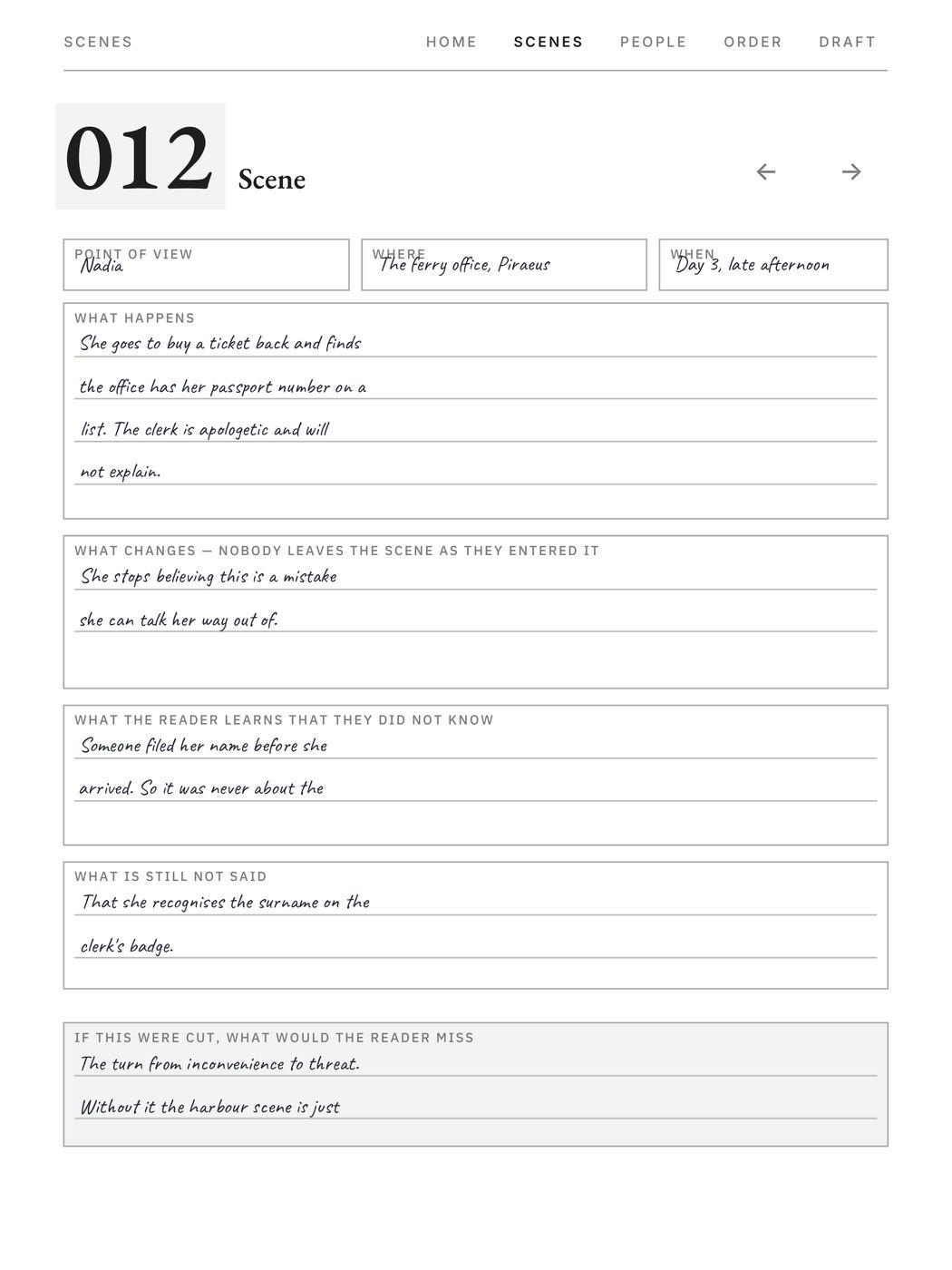
If this scene were cut, what would the reader miss?
$14.99
Instant download · No account · All nine device editions
| Pages | 151 |
|---|---|
| Editions | mono, colour |
| Variants | right hand, left hand |
| Devices | reMarkable 2, reMarkable Paper Pro, reMarkable Paper Pro Move, Kindle Scribe, Kindle Scribe Colorsoft, Supernote Manta, Boox Note Air, A4 Print, US Letter Print |
| Format | Hyperlinked PDF, one file per device |
| Updates | Included, for as long as the template exists |
- 151 pages: 60 scene cards, 12 character sheets, 40 manuscript pages and the story bible around them
- Every scene card ends with the same question — if this were cut, what would the reader miss. A scene that survives it is a scene; one that does not is a passage
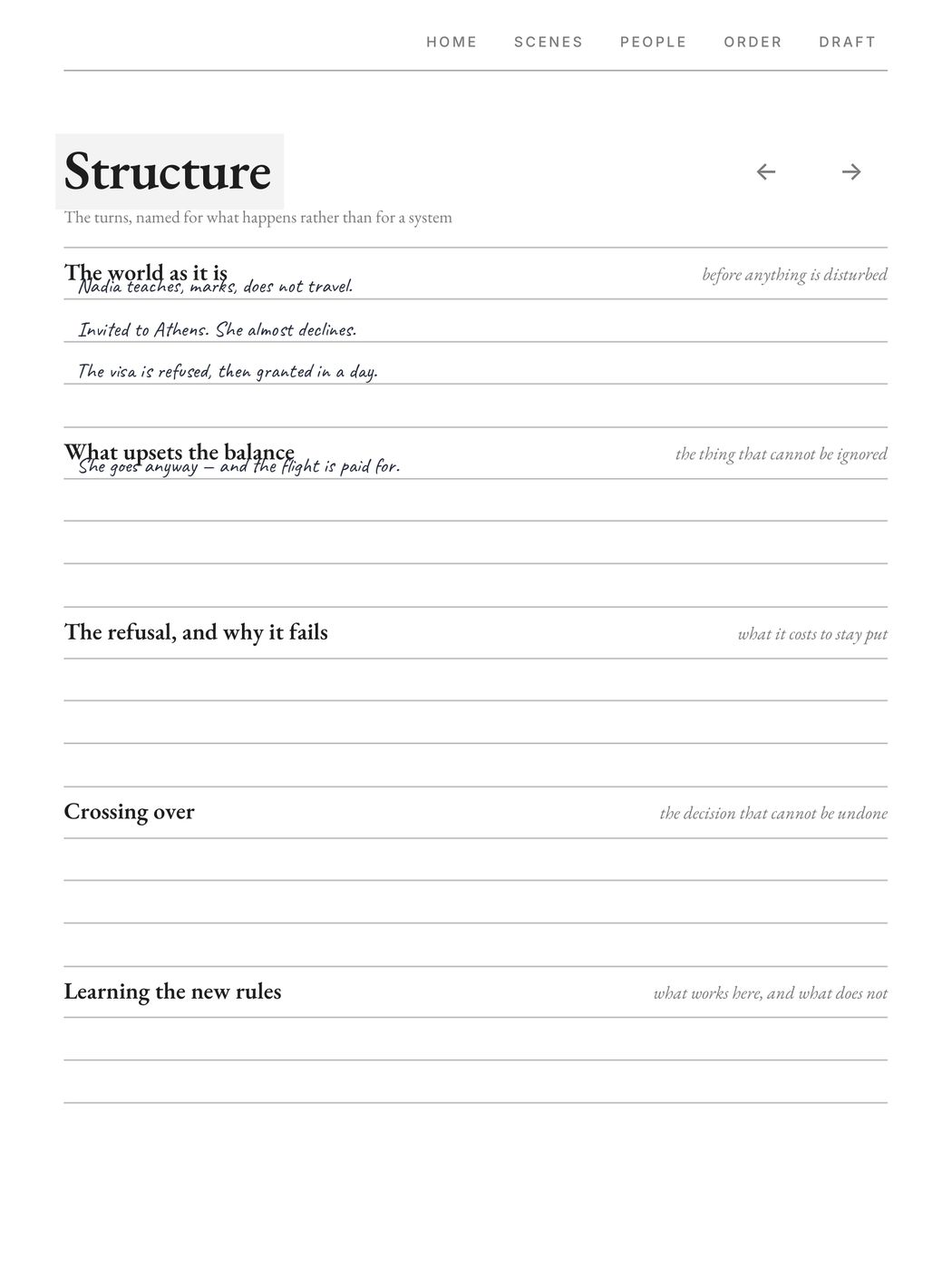
- Structure named in plain language rather than borrowed from anyone's beat sheet — the grammar of a turn is common property
- Two timelines kept apart: the order things happened, and the order the reader is told. Every place they differ is a choice
- Character sheets built on wants against needs, plus what they are wrong about and what they would never do
- A continuity log for the facts you invented, because a long project fails on its own small inconsistencies
- Revision is one pass, one problem — the sheet has no room for a second
- Manuscript pages ruled double-spaced with a wide margin, each ending in the line you stopped mid-sentence on
What is inside
A wall of scene cards bound into a story bible — for e-ink, not converted to it.
Sixty scene cards, twelve character sheets, a structure sheet, two timelines, a running-order list, forty manuscript pages, a continuity log, eight revision passes and a submissions tracker. All linked.
WHAT MAKES IT DIFFERENT
· Every scene card ends with the same question: if this were cut, what would the reader miss? A scene that survives it is a scene; one that does not is a passage — and finding that out on a card is cheaper than finding it out in a third draft
· Structure named in plain language, for what actually happens at each turn, rather than borrowed from any one author's beat sheet
· Two timelines kept apart: what happened, and the order the reader is told. Confusing them is the commonest structural mistake in a first novel and nothing else separates them
· Character sheets built on the pair that matters — what they want against what they need and do not know — plus what they are wrong about and what they would never do
· A continuity log for the facts you invented. Eye colour, the name of the dog, how long the drive takes
· Revision is one pass and one problem. There is no room on the sheet for a second, because fixing everything at once is how a draft gets worse
· Manuscript pages ruled double-spaced with a wide margin, each ending in the line you stopped mid-sentence on, so the next session starts without a blank page
· Scene cards are numbered once and never renumbered; the running order lives on its own pages
· No branding inside. You are buying paper, not an advert.