
Templates / For readers keeping a commonplace book
Reading Journal
Readers who want to keep what they read rather than only count it.
A field for the book you stopped reading.
$9.99
Instant download · No account · All nine device editions
| Pages | 96 |
|---|---|
| Editions | mono, colour |
| Variants | right hand, left hand |
| Devices | reMarkable 2, reMarkable Paper Pro, reMarkable Paper Pro Move, Kindle Scribe, Kindle Scribe Colorsoft, Supernote Manta, Boox Note Air, A4 Print, US Letter Print |
| Format | Hyperlinked PDF, one file per device |
| Updates | Included, for as long as the template exists |
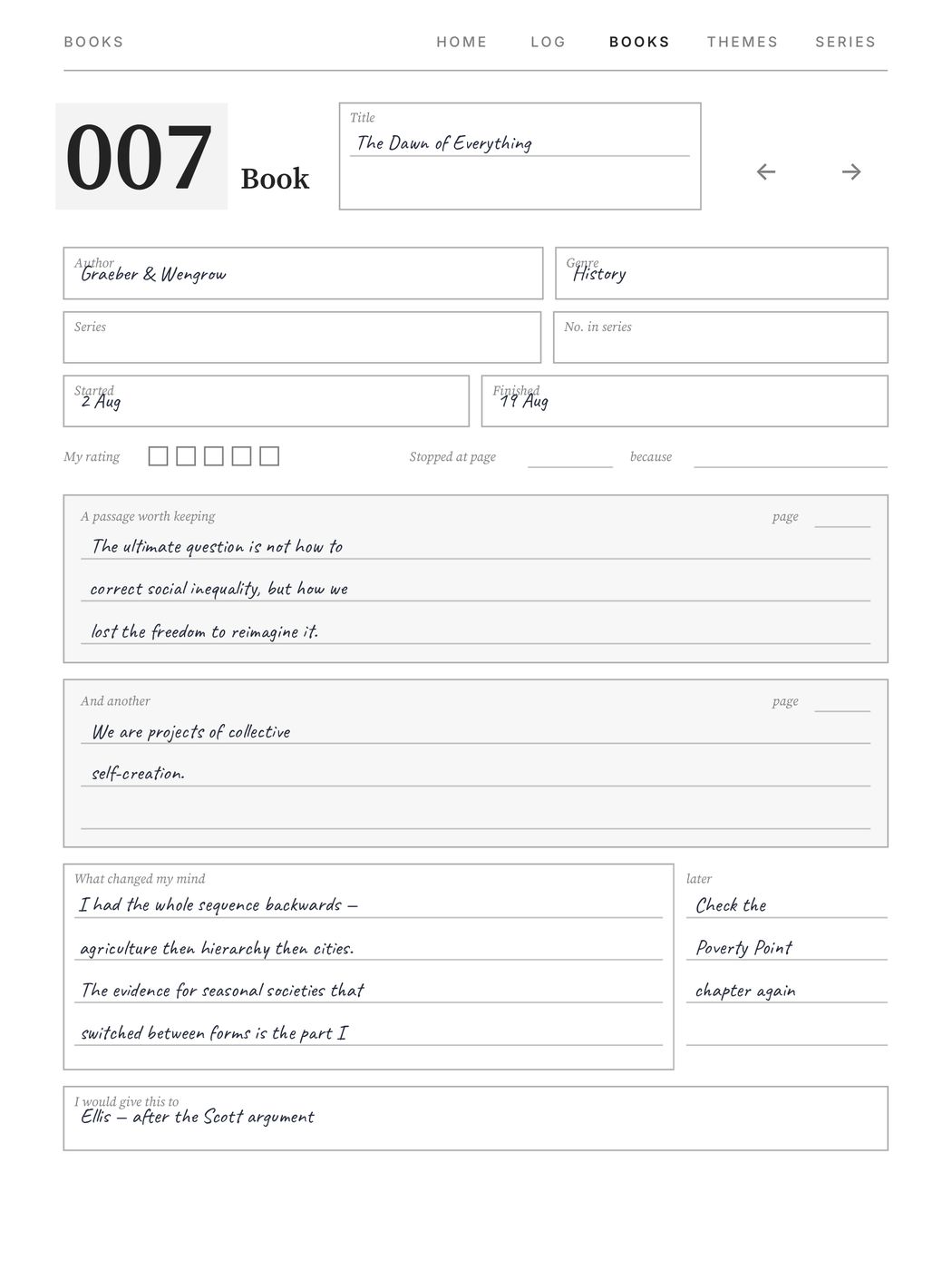
- 96 pages built as a commonplace book: 60 book pages, a reading log, a theme index and series trackers
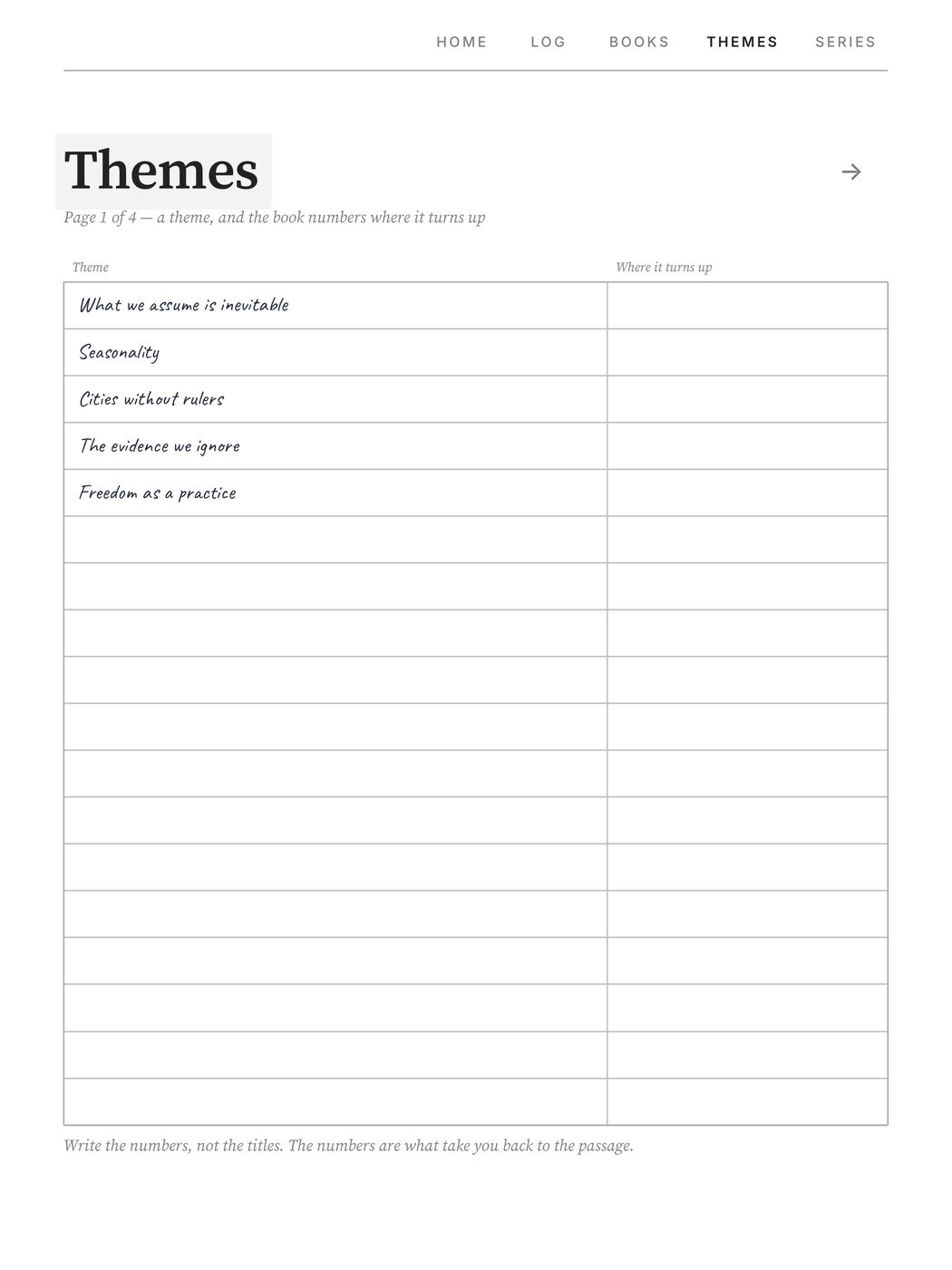
- Four theme index pages you build yourself — a theme on the left, the book numbers on the right, so a year of reading stays reachable by idea rather than only by title
- Every book page holds two passages with their page numbers, because a passage you cannot cite is one you only remember having read
- A field for the book you stopped reading — the page you stopped at and why. Every other reading journal is designed only for books you finished
- "What changed my mind" rather than a blank headed reflections: a specific question gets a specific answer
- A margin beside the reflection for the thought you have on the second read
- Every to-be-read line asks why the book is on the list, because one with no reason beside it is one you never pick up
- Series trackers numbered in reading order, and every log row taps through to that book's page
What is inside
A reading journal built as a commonplace book rather than a log — for e-ink, not converted to it.
Sixty book pages, a five-page reading log, four theme index pages, a to-be-read list, ten series trackers, four year-in-books pages and eight open pages. All linked.
WHAT MAKES IT DIFFERENT
· A theme index you build yourself: a theme on the left, the book numbers on the right. It is the difference between a commonplace book and a stack of quotations, and it is the part every other reading journal leaves out
· Two passages per book, each with a printed box for its page number — a passage you cannot cite is one you only remember having read
· A field for the book you stopped reading: the page you stopped at, and why. Every other journal is designed only for the books you finished
· "What changed my mind" instead of a blank headed reflections. A specific question gets a specific answer
· A margin beside the reflection, for the thought you have on the second read
· Every to-be-read line asks why the book is on the list. One with no reason beside it is one you never pick up
· Every reading-log row taps straight through to that book's page
· Set in a serif with generous leading, because this is the one thing here you will read rather than fill in
· No branding inside. You are buying paper, not an advert.