
Templates / For project and delivery leads
Project Planner
Project, delivery and programme managers, and engineers running their own work.
Every sheet carries a designation: P2-RSK-03.
$12.99
Instant download · No account · All nine device editions
| Pages | 189 |
|---|---|
| Editions | mono, colour |
| Variants | right hand, left hand |
| Devices | reMarkable 2, reMarkable Paper Pro, reMarkable Paper Pro Move, Kindle Scribe, Kindle Scribe Colorsoft, Supernote Manta, Boox Note Air, A4 Print, US Letter Print |
| Format | Hyperlinked PDF, one file per device |
| Updates | Included, for as long as the template exists |
- 189 pages: three projects with charters, timelines, RAID, status, iterations, retros, a task ledger and a budget - plus a running-service section for what happens after it ships
- A debug log where one change goes in at a time and is written down BEFORE it is made, with what you expected beside what happened - the difference between debugging and trying things
- An on-call handover whose last field is what you may do without asking, which is the field that decides whether they ring you at three in the morning
- A severity sheet that asks the three questions deciding a level and prints none of the levels, because every organisation numbers them differently and several number them backwards from each other
- A budget with planned, committed, spent and forecast as four separate columns, because committed is not spent and spent is not forecast
- A task ledger with a blocked-by column: a task with no blocker named is late twice, once when it slips and again when somebody asks why
- 161 sheets: three projects, one shared decision log, every sheet designated
- Every project page carries a title block with a printed designation - P2-RSK-03 - so a page can be named out loud
What is inside
A project book built the way a drawing office builds a document of record — for e-ink, not converted to it.
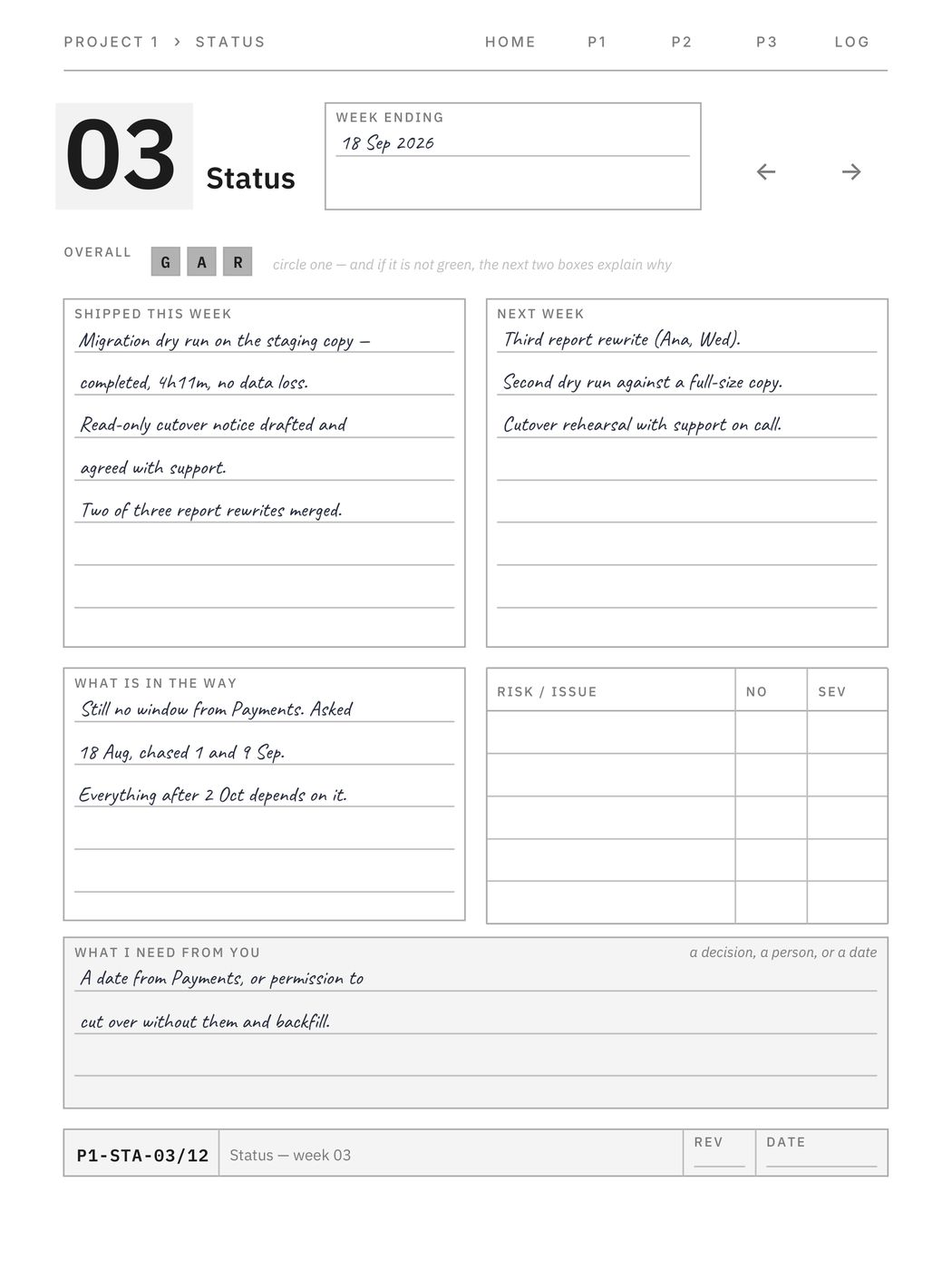
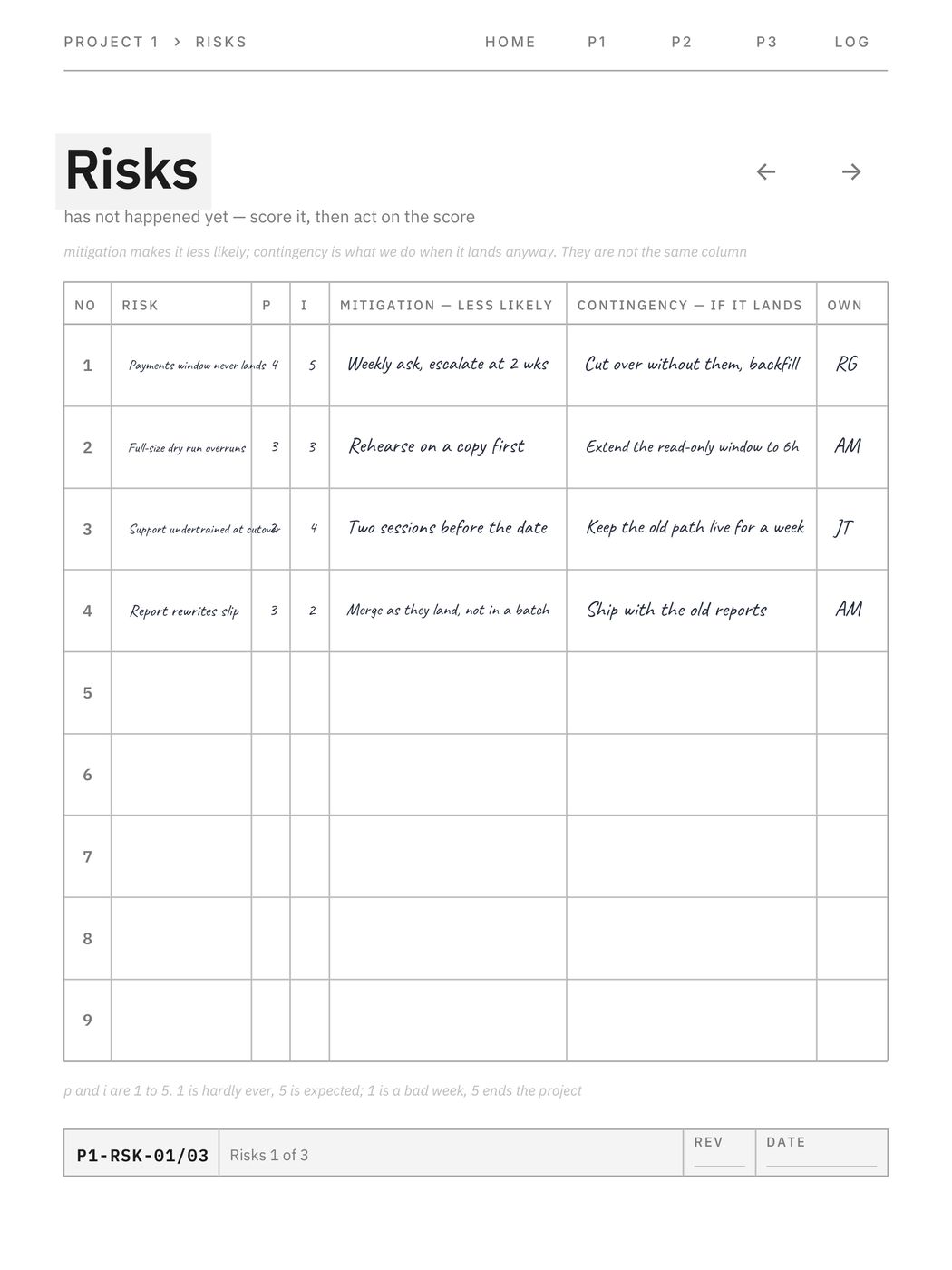
Three projects, each with a charter, two quarter timelines, twelve weekly status sheets, a full RAID set, a change register, a stakeholder map and register, eight iterations and four retros. One shared decision log of forty-eight numbered decisions. All linked.
WHAT MAKES IT DIFFERENT
· Every project sheet carries a title block with a designation this file printed — P2-RSK-03 — so a page can be named in a meeting rather than described
· Charters carry a revision table and an approval strip. A plan nobody signed is a document one person wrote
· RAID keeps mitigation and contingency in separate columns — making a risk less likely and knowing what you do when it lands anyway are different pieces of work
· A weekly status sheet that ends in what I need from you: a decision, a person, or a date
· A change register separate from issues, so scope that moved is recorded rather than quietly absorbed
· Status is a chip with a letter on it, so it reads identically on a mono panel and a colour one
· Every decision records what was true at the time, which is what makes it defensible later rather than merely written down
· No branding inside. You are buying paper, not an advert.