
Templates / For owners who run cash and people
Owners Book
Owner-operators of small businesses with staff, stock or a premises.
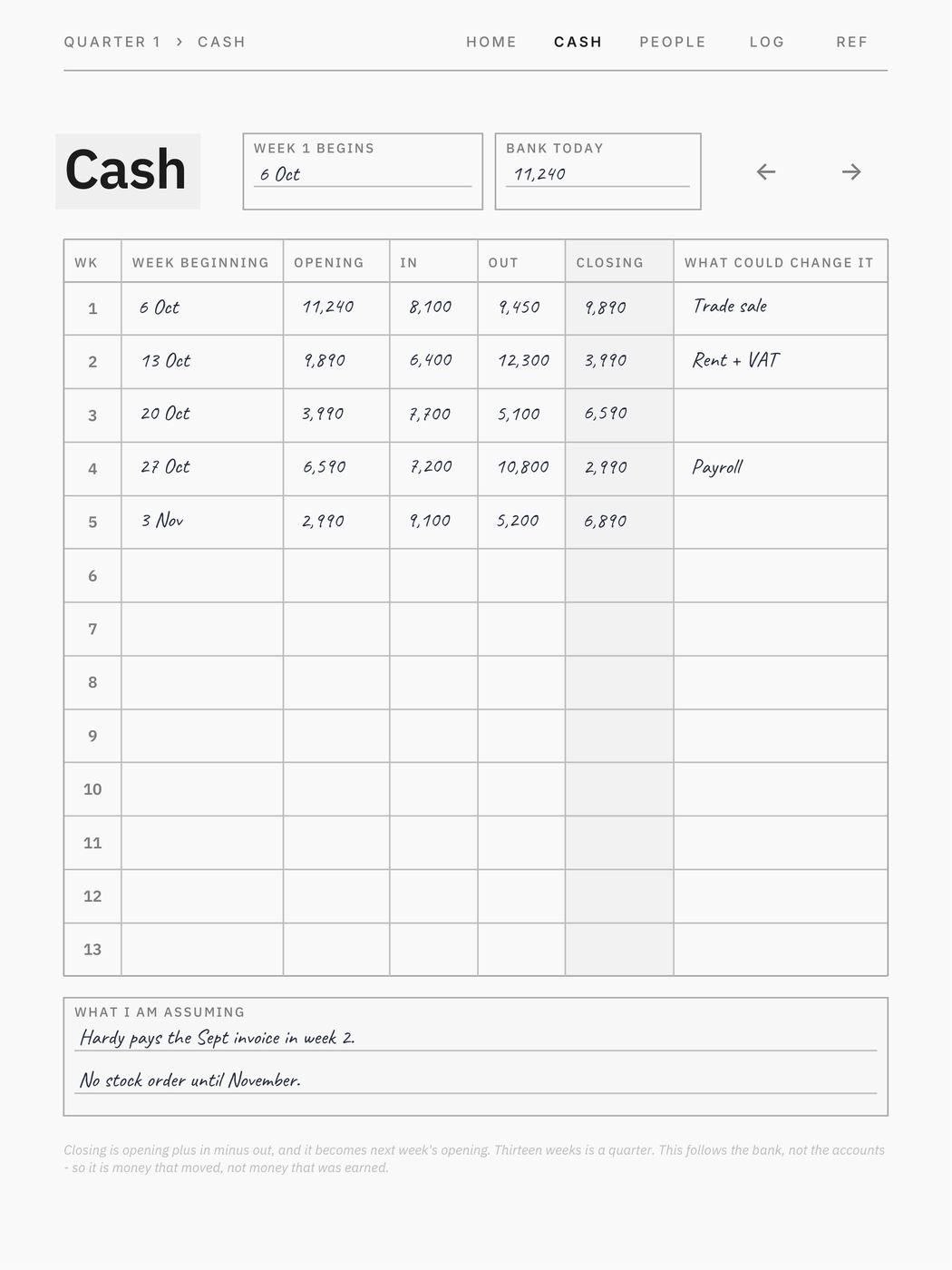
Thirteen weeks down the page, closing into next week's opening.
$14.99
Instant download · No account · All nine device editions
| Pages | 154 |
|---|---|
| Editions | mono, colour |
| Variants | right hand, left hand |
| Devices | reMarkable 2, reMarkable Paper Pro, reMarkable Paper Pro Move, Kindle Scribe, Kindle Scribe Colorsoft, Supernote Manta, Boox Note Air, A4 Print, US Letter Print |
| Format | Hyperlinked PDF, one file per device |
| Updates | Included, for as long as the template exists |
- 154 pages filed by quarter and by person - four quarters, each with a thirteen-week cash calendar, an in-and-out breakdown, a one-page plan and thirteen weekly reviews
- The cash calendar runs the weeks down the page, not across, so every figure has a column you can actually write in - and the closing balance carries into the next week's opening, which is the whole method
- A what-I-am-assuming box under the table, because when the closing balance is wrong that is the only thing that tells you which guess was
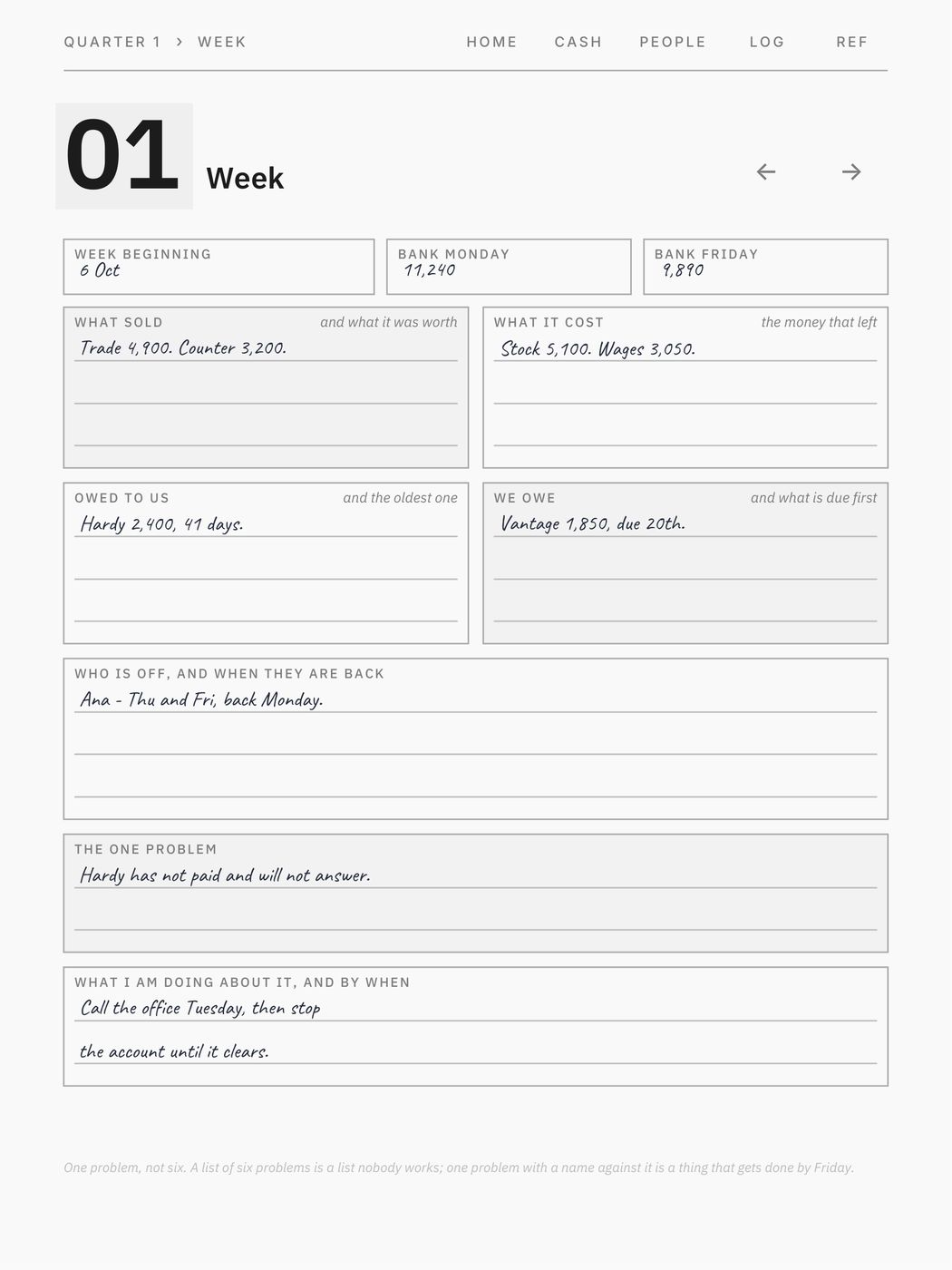
- The weekly review has one problem box, not a list. A list of six problems is a list nobody works
- A one-page plan with three boxes and no fourth line, and a field for what would tell you it is not working - written while it is still a plan
- Supplier records with a last-price-paid ledger under each one, because a price rise arrives one invoice at a time and is invisible without it
- A price-change log with a who-was-told column - the one that gets missed, and the one a customer notices
- Owed-to-us pages carry a chased-on column beside the due date, because the date you chased is the one that predicts payment
What is inside
For the owner who runs cash and people — not billable hours.
Filed by quarter and by person. Four quarters, each with a thirteen-week cash calendar, an in-and-out breakdown, a one-page plan and thirteen weekly operating reviews. Plus supplier records with a last-price-paid ledger, money owed both ways, a price-change log, eight staff records with their one-to-ones, hiring scorecards and a numbered decision log. 154 pages, all linked.
WHAT MAKES IT DIFFERENT
· The thirteen-week cash calendar runs the weeks DOWN the page instead of across. Thirteen columns on a portrait screen is twenty-two points each, which is not a column anyone can write a figure in. The arithmetic is unchanged — closing is opening plus in minus out, and it becomes next week's opening
· A "what I am assuming" box under the table. When the closing balance turns out wrong, that box is the only thing that tells you which guess was
· It follows the bank, not the accounts. Money that moved, not money that was earned — which is the only version an owner can keep by hand
· The weekly review has one problem box, not a list. A list of six problems is a list nobody works; one problem with a name against it gets done by Friday
· The one-page plan has three boxes and no fourth line. A quarter with six priorities has none, and a form that offers a fourth line will be given a fourth priority
· Every supplier record carries a last-price-paid ledger with a unit column. A price rise arrives one invoice at a time and is invisible without one
· The price-change log has a who-was-told column. It is the one that gets missed and the one a customer notices
· Owed-to-us pages have a chased-on column beside the due date, because the date you chased is what predicts payment
· Hiring scorecards are written before anybody is met, with an evidence column beside every must-have. A scorecard filled in afterwards is a record of who you liked
· No tax rate, no payroll percentage, no filing date and no reserve rule appears anywhere. All four are local, all four move, and a reference page says so in those words
· No branding inside. You are buying paper, not an advert.