
Templates / For pit, orchestral and function players
Musicians Book
Pit, orchestral, function-band, church and chamber musicians.
Rehearsal letters skip I, J and O, so K follows H.
$14.99
Instant download · No account · All nine device editions
| Pages | 147 |
|---|---|
| Editions | mono, colour |
| Variants | right hand, left hand |
| Devices | reMarkable 2, reMarkable Paper Pro, reMarkable Paper Pro Move, Kindle Scribe, Kindle Scribe Colorsoft, Supernote Manta, Boox Note Air, A4 Print, US Letter Print |
| Format | Hyperlinked PDF, one file per device |
| Updates | Included, for as long as the template exists |
- 147 pages filed by show, for the player whose music is already on the device - this is the paper that goes around it, not more of it
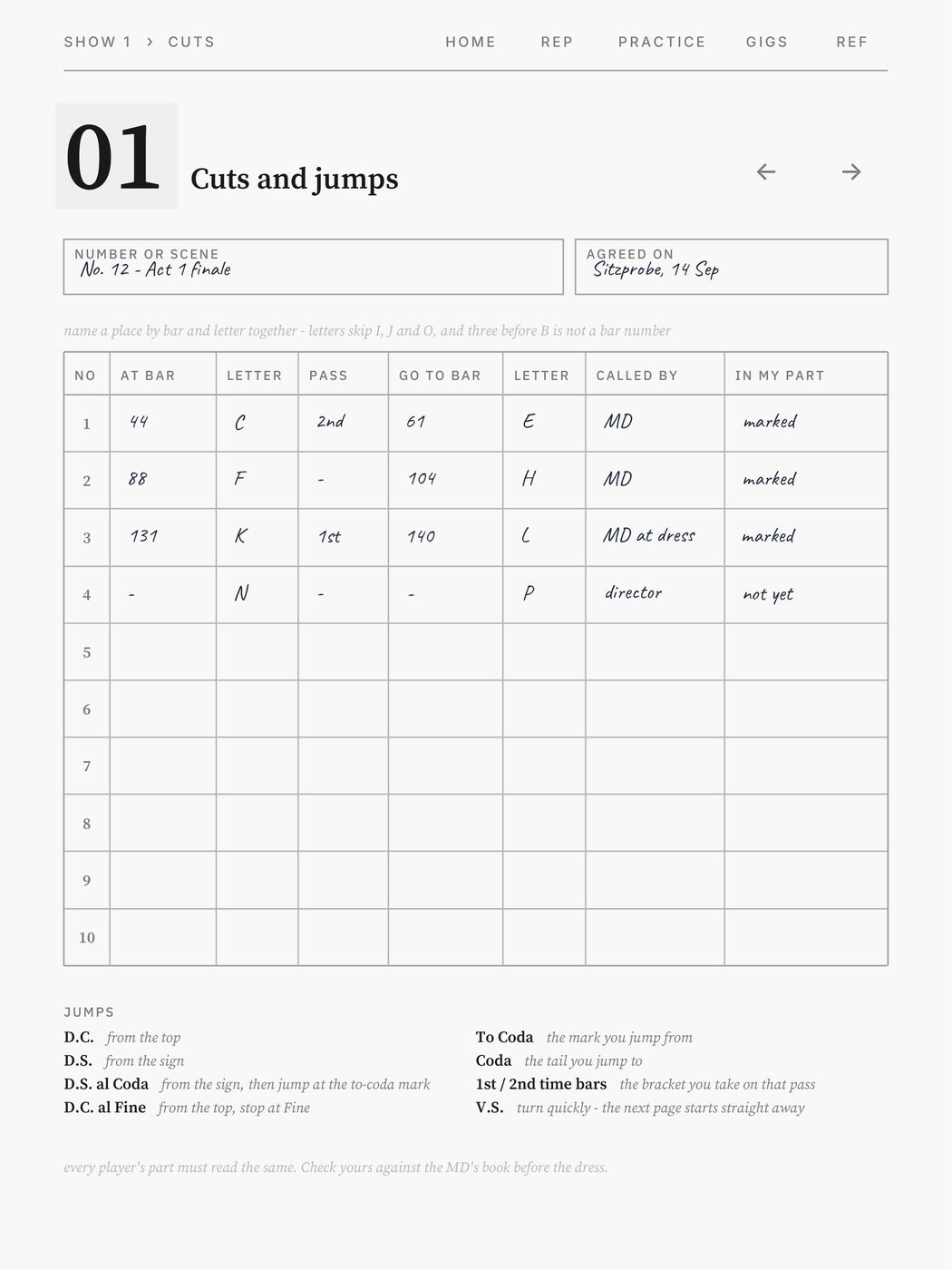
- 12 cut and jump sheets: a cut named by bar and rehearsal letter together, who called it, and the date it was agreed
- Every cut sheet prints the line that prevents the failure - every player's part must read the same, so check yours against the MD's book before the dress
- Rehearsal letters skip I, J and O, so K follows H. The file says so, because half a pit finding a different bar is what happens when it does not
- What a written C sounds on eight transposing instruments, printed once - the arithmetic a player does in their head all night
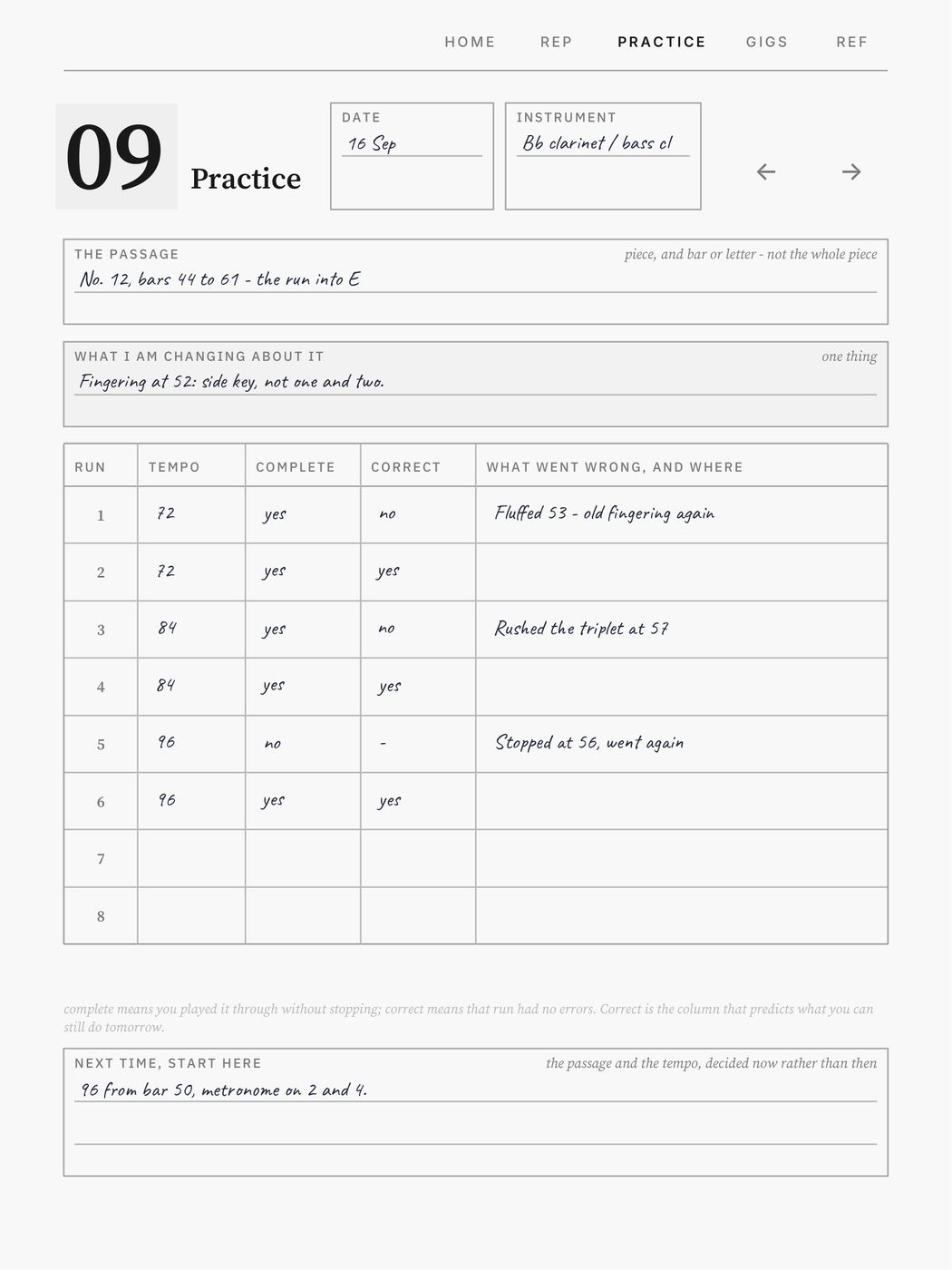
- 48 practice pages that count complete run-throughs played correctly rather than hours, because that is the measure the practice-room research actually supports
- No hours target and no beats-per-minute value appears anywhere: the ten thousand hours figure is not supported by the evidence it is cited from, and the published tempo ranges contradict each other
- 16 running orders with key, tempo, count-in, who leads and what it goes into - and a printed line saying those conventions are your band's, not the file's
What is inside
The paper that goes around the score — for the player whose music is already on this device.
Filed by show, not by date. Four shows, each with running orders, cut and jump sheets, rehearsal notes, a doublings sheet and a dep handover. Then a repertoire index of 120 numbered pieces, 48 practice pages, a gig and fee log, and twelve pages of manuscript. All linked.
WHAT MAKES IT DIFFERENT
· The cut and jump sheet: a cut named by bar and rehearsal letter together, who called it, and the date it was agreed — with the line printed at the foot that prevents the actual failure, which is a cut half the pit heard
· Rehearsal letters skip I, J and O, so K follows H. The file prints that, because "three before B" is not a bar number
· What a written C sounds on eight transposing instruments, printed once — the arithmetic you do in your head all night
· Practice pages that count complete run-throughs played correctly rather than hours. In the study that measured it, that proportion predicted what a player could still do the next day; total practice time did not
· No hours target anywhere. The ten thousand hours figure is not supported by the evidence it is usually cited from, and this file does not pretend otherwise
· No beats-per-minute printed against any Italian term — the published ranges contradict each other, so the page asks for the number you were given
· A dep handover you can hand to whoever covers you, and a doublings sheet asking how many bars there are to make the change
· Nothing here asks to be written on a part. Parts carry pencil symbols; this is the separate paper everything else belongs on
· No branding inside. You are buying paper, not an advert.