
Templates / For private music teachers
Music Teachers Book
Private instrumental and voice teachers with ten to thirty pupils.
Correct run-throughs, not minutes.
$12.99
Instant download · No account · All nine device editions
| Pages | 143 |
|---|---|
| Editions | mono, colour |
| Variants | right hand, left hand |
| Devices | reMarkable 2, reMarkable Paper Pro, reMarkable Paper Pro Move, Kindle Scribe, Kindle Scribe Colorsoft, Supernote Manta, Boox Note Air, A4 Print, US Letter Print |
| Format | Hyperlinked PDF, one file per device |
| Updates | Included, for as long as the template exists |
- 143 pages filed by pupil, not by date - twelve pupils, each with a front sheet, eight lesson sheets and a repertoire ledger
- The practice target is a count of correct run-throughs and the bars they run between, not a number of minutes
- Because across studies practice time accounts for about a fifth of the variance in performance, and the proportion of complete trials played correctly predicts what a player can still do the next day better than time, repetitions or complete runs do
- There is no minutes field anywhere in the file, which is the one thing every other lesson book prints
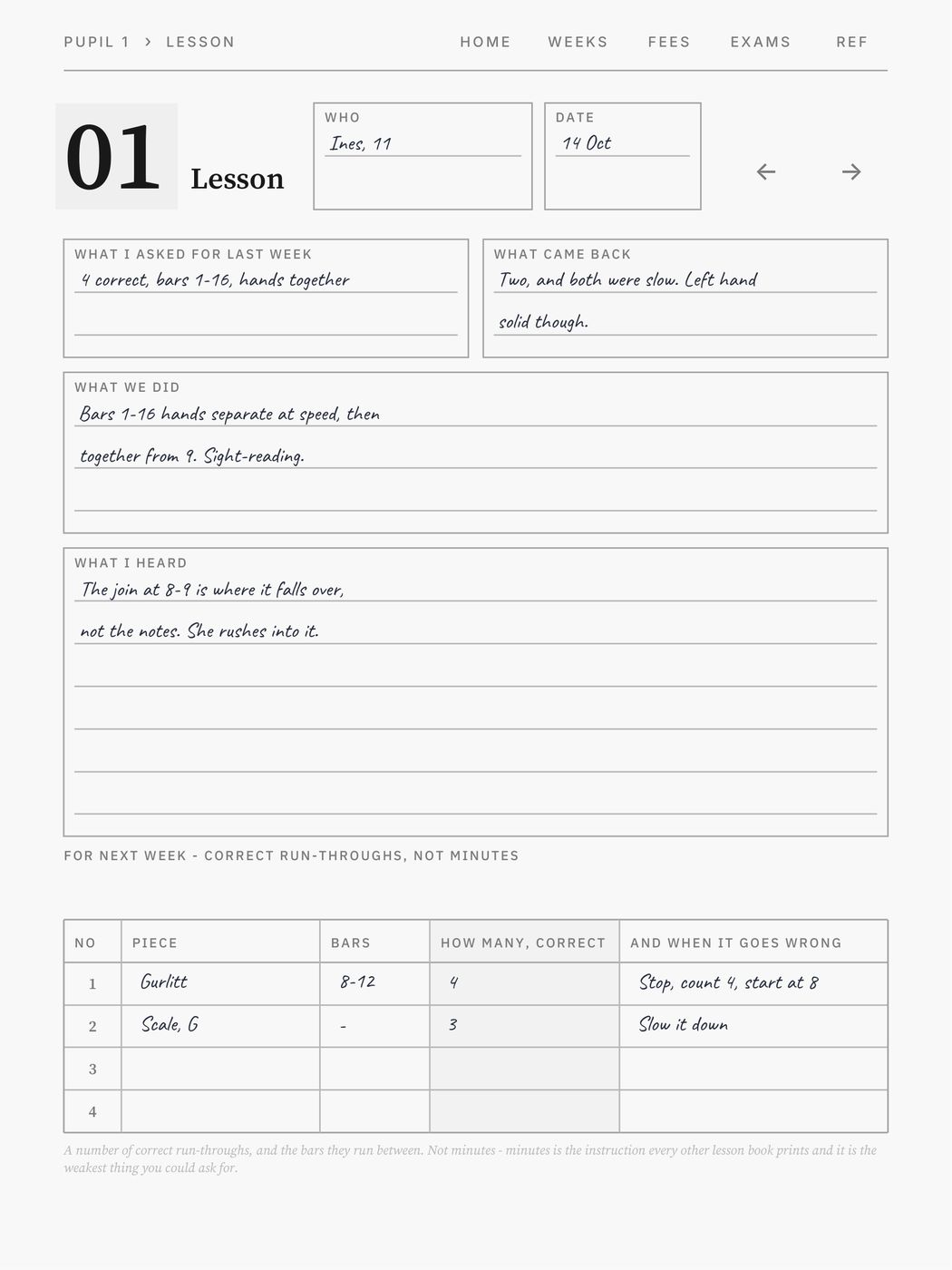
- Every lesson sheet opens with what you asked for last week and what actually came back, side by side - so eight lessons are one conversation, not eight Tuesdays
- A line for what they will do when it goes wrong: the difference between a pupil who starts again and one who works
- Name the passage, not the piece - a target that names the whole piece gets practised from the beginning every time, which is why the beginning is always the best bit
- Exam sheets carry the board, level, deadline and result fields and none of the answers, because syllabuses are copyrighted, change on their own schedule and differ by country
What is inside
Filed by pupil, not by date — because the question at 4.15 on a Tuesday is "where were we".
Twelve pupils, each with a front sheet, eight lesson sheets and a repertoire ledger. Plus teaching timetables, a fee log, exam entry sheets and two reference pages. 143 pages, all linked.
WHAT MAKES IT DIFFERENT
· The week's practice target is a count of correct run-throughs and the bars they run between — not a number of minutes. There is no minutes field anywhere in this file
· That is not an opinion. Across studies, practice time accounts for roughly a fifth of the variance in music performance; in the practice-room study that measured it, the proportion of complete trials played correctly predicted what a player could still do the next day better than total time, total repetitions or the number of complete runs
· "Four correct, hands together, from bar 9" is checkable on Tuesday. "Twenty minutes a day" is not, and it is what every other lesson book asks for
· Every lesson sheet opens with what you asked for last week and what actually came back, side by side. Eight lesson sheets are then one conversation rather than eight Tuesdays
· A line for what they will do when it goes wrong — the difference between a pupil who stops and starts again and one who works. It fits on one line and almost nobody asks for it
· Name the passage, not the piece. A target that names the whole piece gets practised from the beginning every time, which is why the beginning is always the best bit
· Exam sheets carry the board, the level, the deadline and the result — and none of the answers. Syllabuses and set pieces are published and copyrighted by the boards, change on their own schedule, and differ by country
· No tempo in beats per minute anywhere, because the published ranges for the Italian terms contradict each other
· A fee ledger with lessons given, invoiced and paid, and no rate printed — it is yours, and it is local
· No branding inside. You are buying paper, not an advert.