
Templates / For marketers who write the brief
Marketers Book
In-house and agency marketers who write briefs and run campaigns.
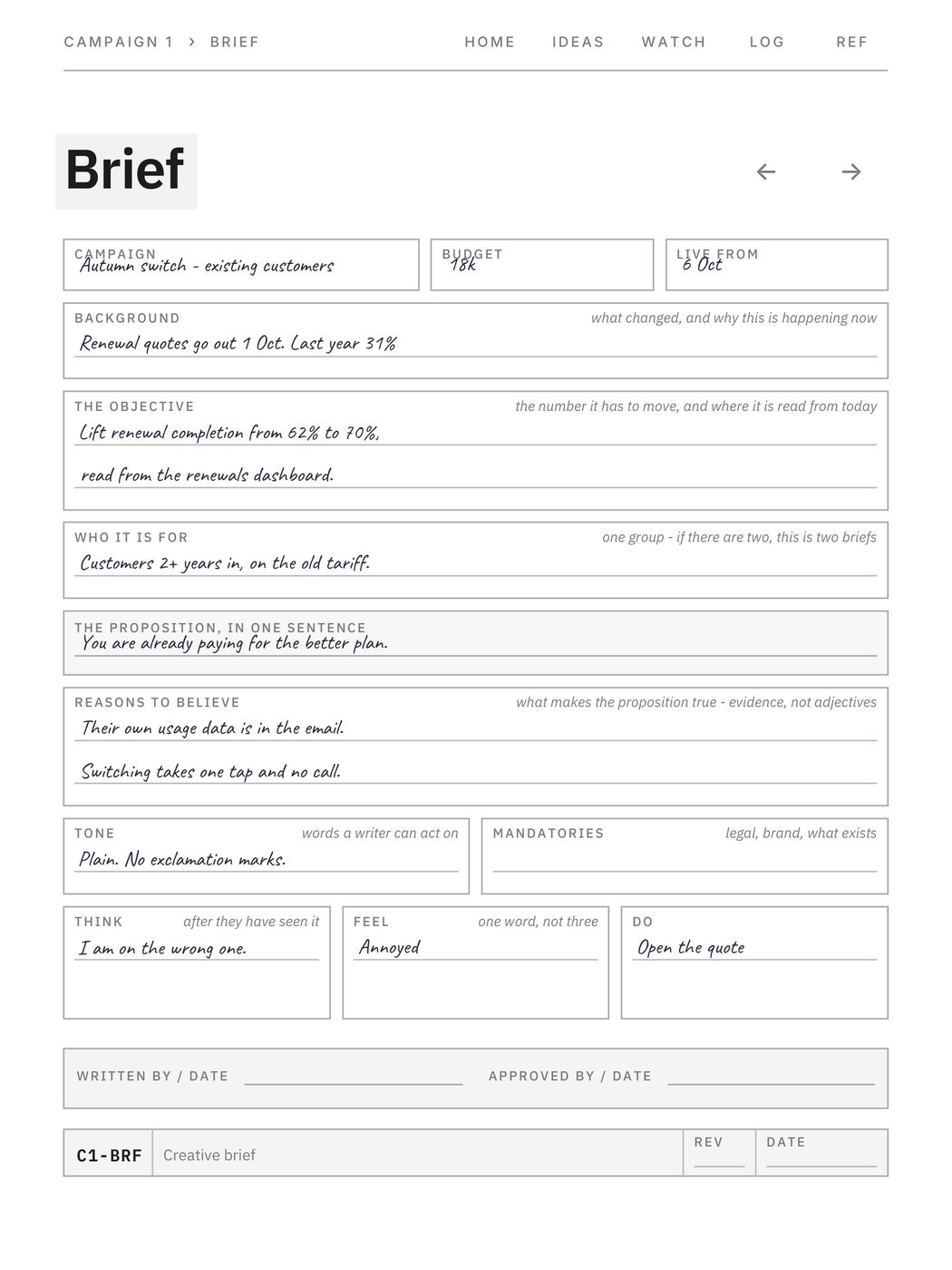
The proposition is one line, because a box gets a paragraph.
$14.99
Instant download · No account · All nine device editions
| Pages | 138 |
|---|---|
| Editions | mono, colour |
| Variants | right hand, left hand |
| Devices | reMarkable 2, reMarkable Paper Pro, reMarkable Paper Pro Move, Kindle Scribe, Kindle Scribe Colorsoft, Supernote Manta, Boox Note Air, A4 Print, US Letter Print |
| Format | Hyperlinked PDF, one file per device |
| Updates | Included, for as long as the template exists |
- 138 pages across eight campaigns, in the order the work happens: brief, audience, messages, three concept sheets, channels, launch, three review meetings, post-mortem
- The creative brief with the proposition drawn as one line, not a box - because a box that holds a paragraph gets a paragraph, and the whole discipline of the field is that it is one sentence
- Think, feel and do asked as three separate boxes, because a brief that only asks what they should do gets work nobody believes
- An audience sheet where every line has a known box and an assumed box - half of any audience description is invention, and this is the only thing that keeps which half visible
- A message house drawn as the building it is named after: one roof, three pillars, and a numbered foundation where every proof carries its source
- Eight concept boxes per sheet with a ruled line under each for the line it would run with - a concept with no words under it is a drawing
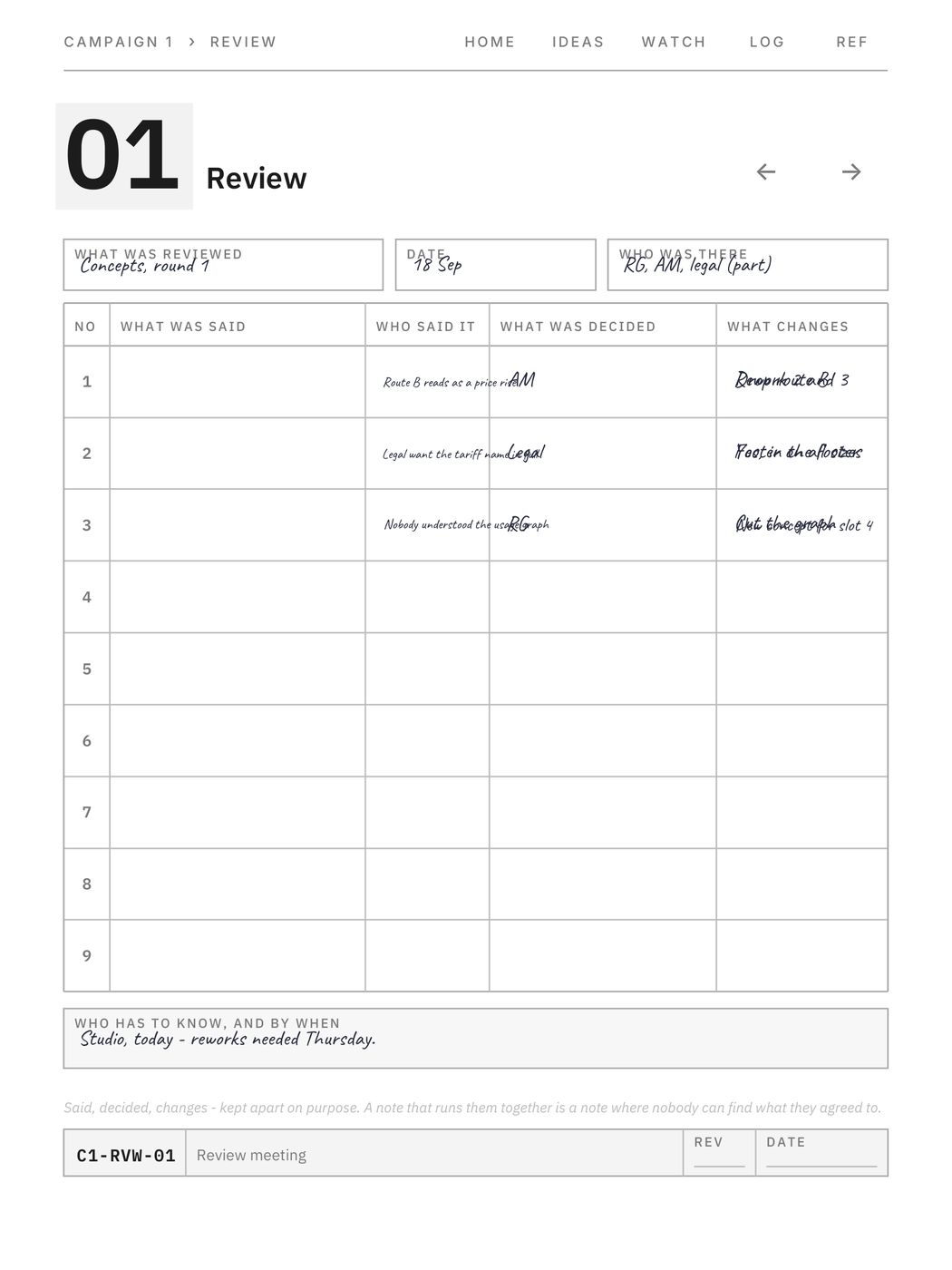
- Review meetings with what was said, what was decided and what changes in three separate columns, and a box for who has to know by when
- A post-campaign review with planned, actual and your own last campaign side by side - and no benchmark printed anywhere in the file
What is inside
Filed by campaign, not by month — for the marketer who writes the brief and then has to live with it.
Eight campaigns, each running in the order the work happens: creative brief, audience sheet, message house, three concept sheets, channel plan, launch checklist, three review meetings and a post-campaign review. Plus an ideas ledger, a competitor watch, a numbered decision log and a reference section. 138 pages, all linked.
THERE IS NO CALENDAR IN THIS BOOK
That is deliberate. The marketing calendar is the commodity in this category — a month grid is a month grid, and you already have one. What nobody sells for e-ink is the paper around the campaign.
WHAT MAKES IT DIFFERENT
· The brief draws the single-minded proposition as one line rather than a box. Every other field on the sheet fills its own height; this one is a rule, because the discipline of the field is that it is one sentence and a box that can hold a paragraph will be given a paragraph
· The audience sheet gives every line a known box and an assumed box. Half of any audience description is research and half is invention, they are written in the same handwriting, and by the time the work is being made nobody can tell which was which
· Think, feel and do are three separate boxes. A brief that asks only what they should do gets work nobody believes; one that asks only how they should feel gets work nobody acts on
· The message house is drawn as the building it is named after — one roof, three pillars, a numbered foundation — with a column for where each proof came from, and the rule printed that two pillars saying the same thing are one pillar
· Review meetings keep what was said, what was decided and what changes in three columns. A note that runs them together is a note where nobody can find what they agreed to
· The post-campaign review puts planned, actual and your own last campaign side by side. No benchmark is printed anywhere in this file — an open rate or a cost per mille is true of one industry, one list and one quarter
· No asset size, no character limit and no platform name appears anywhere. The channel plan has a dated "specs checked" box instead, because a printed dimension is wrong within a quarter — and a file with no platform names in it does not go stale when one is renamed
· Eight concept boxes to a sheet, each with a ruled line under it for the line. The seventh idea is the point, not the first
· Every sheet carries a printed designation — C3-RVW-02 — so a page can be named in a meeting or cited in an email, and the campaign front sheet carries the revision table
· The reference section prints what is deliberately blank and why, which is the part every other template leaves out
· No branding inside. You are buying paper, not an advert.