
Templates / For knitters, crocheters and sewists
Knitters and Makers
Knitters, crocheters and sewists who keep project records.
Chart paper ruled the shape a stitch actually is.
$9.99
Instant download · No account · All nine device editions
| Pages | 117 |
|---|---|
| Editions | mono, colour |
| Variants | right hand, left hand |
| Devices | reMarkable 2, reMarkable Paper Pro, reMarkable Paper Pro Move, Kindle Scribe, Kindle Scribe Colorsoft, Supernote Manta, Boox Note Air, A4 Print, US Letter Print |
| Format | Hyperlinked PDF, one file per device |
| Updates | Included, for as long as the template exists |
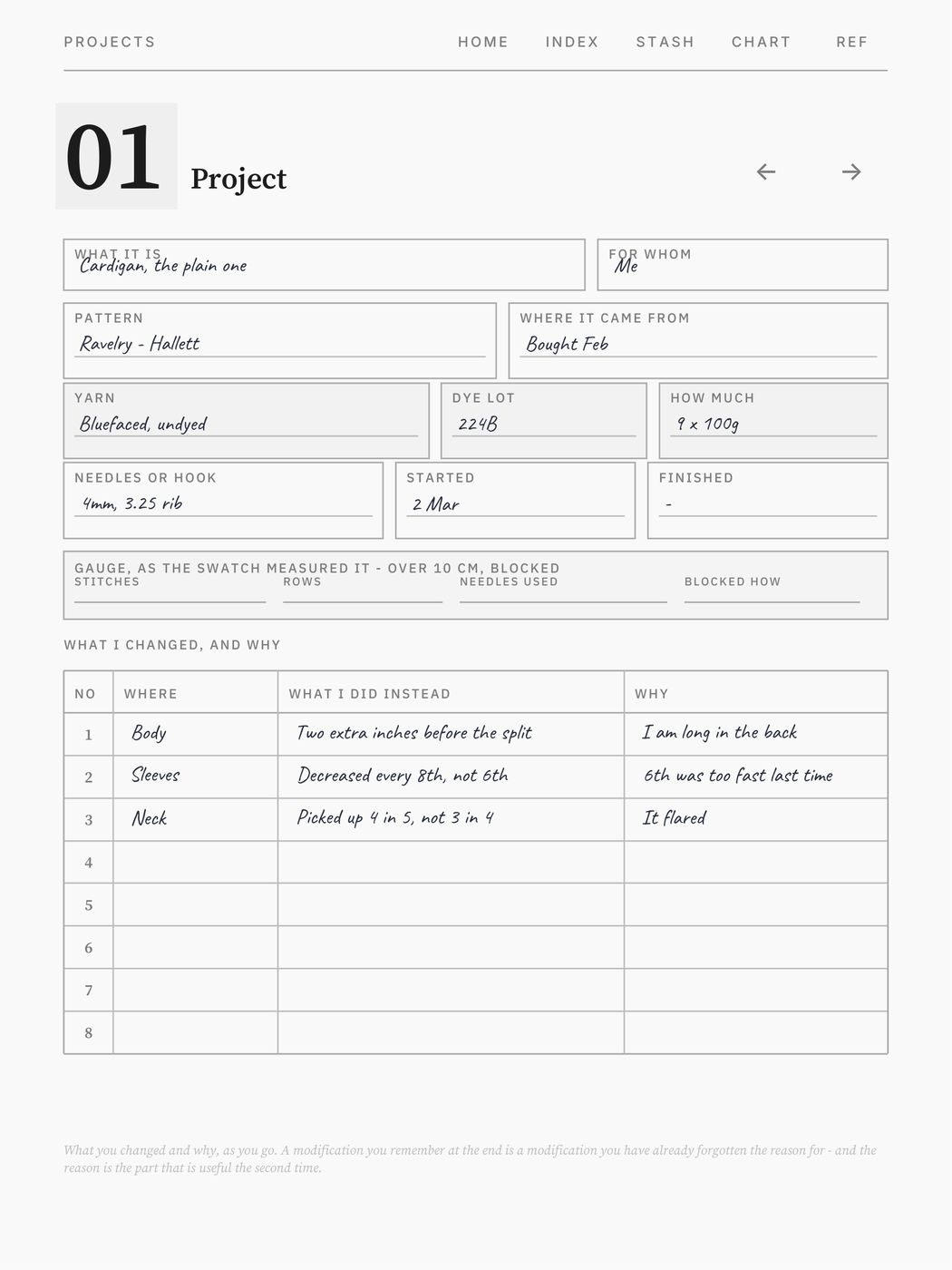
- 117 pages: twenty projects, each with a sheet, two chart pages and a notes page, plus spare chart paper of both kinds
- The knitter's chart paper is not square. A stitch is wider than a row is tall - near four stitches to five rows - so a design charted on squares knits out about a fifth taller than it was drawn
- Which is why a circle charted on square paper comes off the needles as an oval. These pages are ruled at the shape of the stitch
- Square pages too, for crochet and counted work, because a crochet chart is not a stitch map in the same way
- The gauge box asks what the swatch measured, never a target: over ten centimetres, in the middle of a swatch bigger than that, after blocking, with the needles you actually used
- Rows as well as stitches, because row gauge decides length and it is the one people skip - and then the sleeve is right round and wrong long
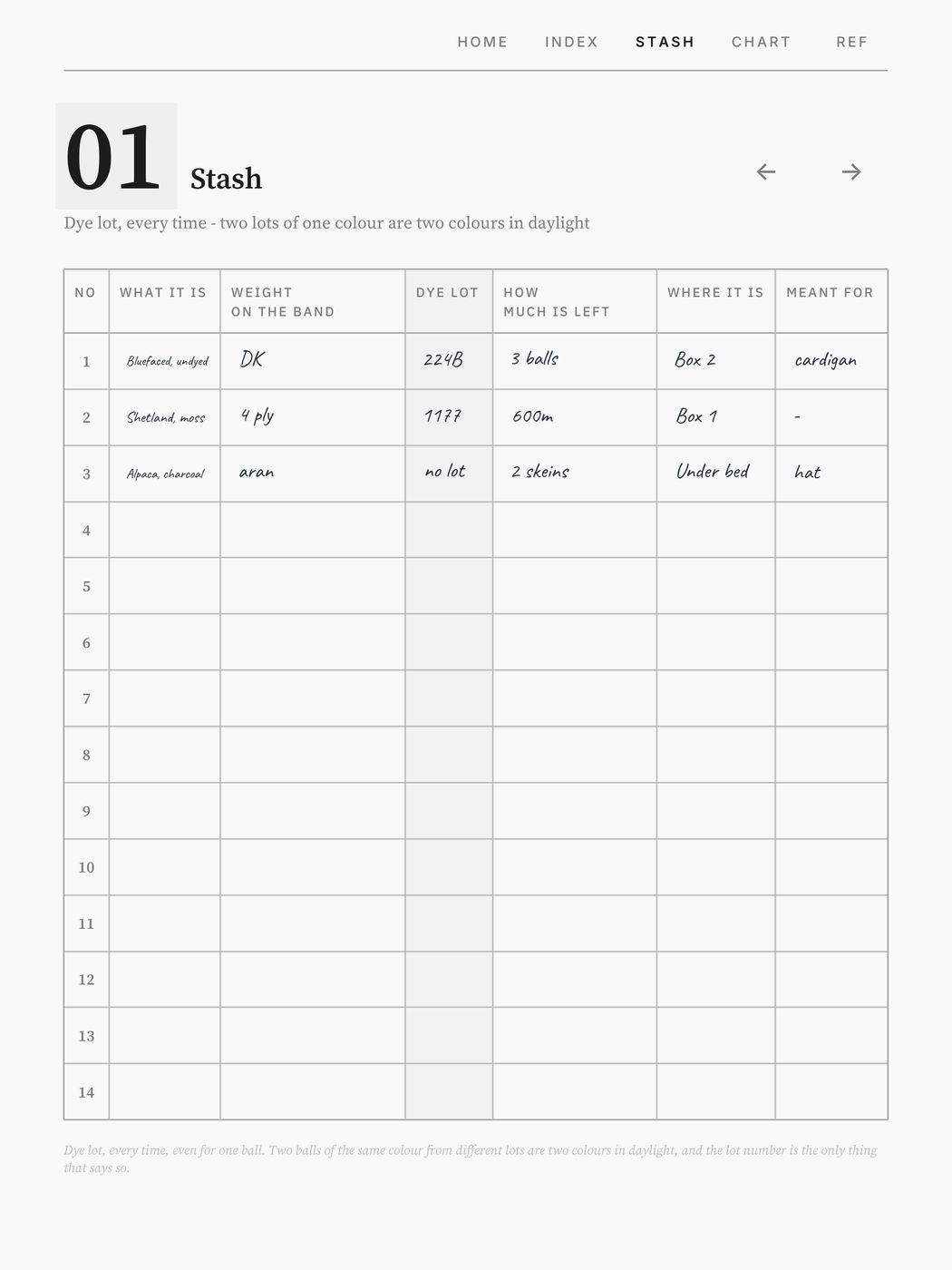
- Dye lot beside the yarn on every project sheet and every stash row: two lots of one colour are two colours in daylight
- A modifications log with a why column, filled in as you go - a change you remember at the end is one whose reason you have already forgotten
What is inside
The chart paper is not square, and that is the point.
Twenty projects, each with a sheet, two chart pages and a notes page. Plus ten spare knitter's chart pages, six square ones, a stash ledger, a needle inventory, a queue and three reference pages. 117 pages, all linked.
WHAT MAKES IT DIFFERENT
· A knitted stitch is wider than a row is tall — stocking stitch in most yarns sits near four stitches to five rows over the same length. So a design charted on square paper knits out about a fifth taller than it was drawn, and a circle charted on squares comes off the needles as an oval
· These chart pages are ruled at that proportion. The reference page draws both rulings side by side so you can see the difference rather than take our word for it
· Square pages too, for crochet and counted work — because a crochet chart is not a stitch map in the way a knitted one is
· The gauge box asks what your swatch measured, never a target: over ten centimetres, in the middle of a swatch bigger than that, after blocking, with the needles you actually used
· Rows as well as stitches. Row gauge decides length and it is the one everyone skips — and then the sleeve is right round and wrong long
· Dye lot beside the yarn on every project sheet and every stash row. Two lots of one colour are two colours in daylight, and the lot number is the only thing that says so
· A modifications log with a why column, filled in as you go. A change you remember at the end is one whose reason you have already forgotten, and the reason is the useful part the second time
· The trade names, country by country: UK 4 ply is US fingering, UK double knitting is US DK, UK aran is roughly US worsted, UK chunky is US bulky — and US sport has no clean UK name at all
· Including the one that actually catches people: American worsted and British aran are near neighbours rather than the same thing, and American "aran" is often heavier than British aran
· No numbered weight category or symbol is reproduced — those belong to the body that publishes them. No target gauge, no needle rule and no yardage estimate is printed anywhere
· No branding inside. You are buying paper, not an advert.