
Templates / For freelancers and consultants
Freelancers Ledger
Freelancers, independent consultants and solo service businesses.
Ten minutes is 0.17 of an hour, not 0.1.
$13.99
Instant download · No account · All nine device editions
| Pages | 164 |
|---|---|
| Editions | mono, colour |
| Variants | right hand, left hand |
| Devices | reMarkable 2, reMarkable Paper Pro, reMarkable Paper Pro Move, Kindle Scribe, Kindle Scribe Colorsoft, Supernote Manta, Boox Note Air, A4 Print, US Letter Print |
| Format | Hyperlinked PDF, one file per device |
| Updates | Included, for as long as the template exists |
- 164 pages filed by client - and every client now carries an estimate, a quoted-against-actual sheet, a scope, a change log and four call records
- The estimate is by piece with an assumption column beside every line, because a single number for the whole job is one you cannot defend when one piece turns out to be double
- The quoted-against-actual sheet is filled in afterwards from the day sheets and ends in what you will quote differently - the only way to find out what you are bad at estimating
- Four engagement pages for consulting work: the problem they think they have against the problem you think they have, who decides, what done looks like, and what you will not do
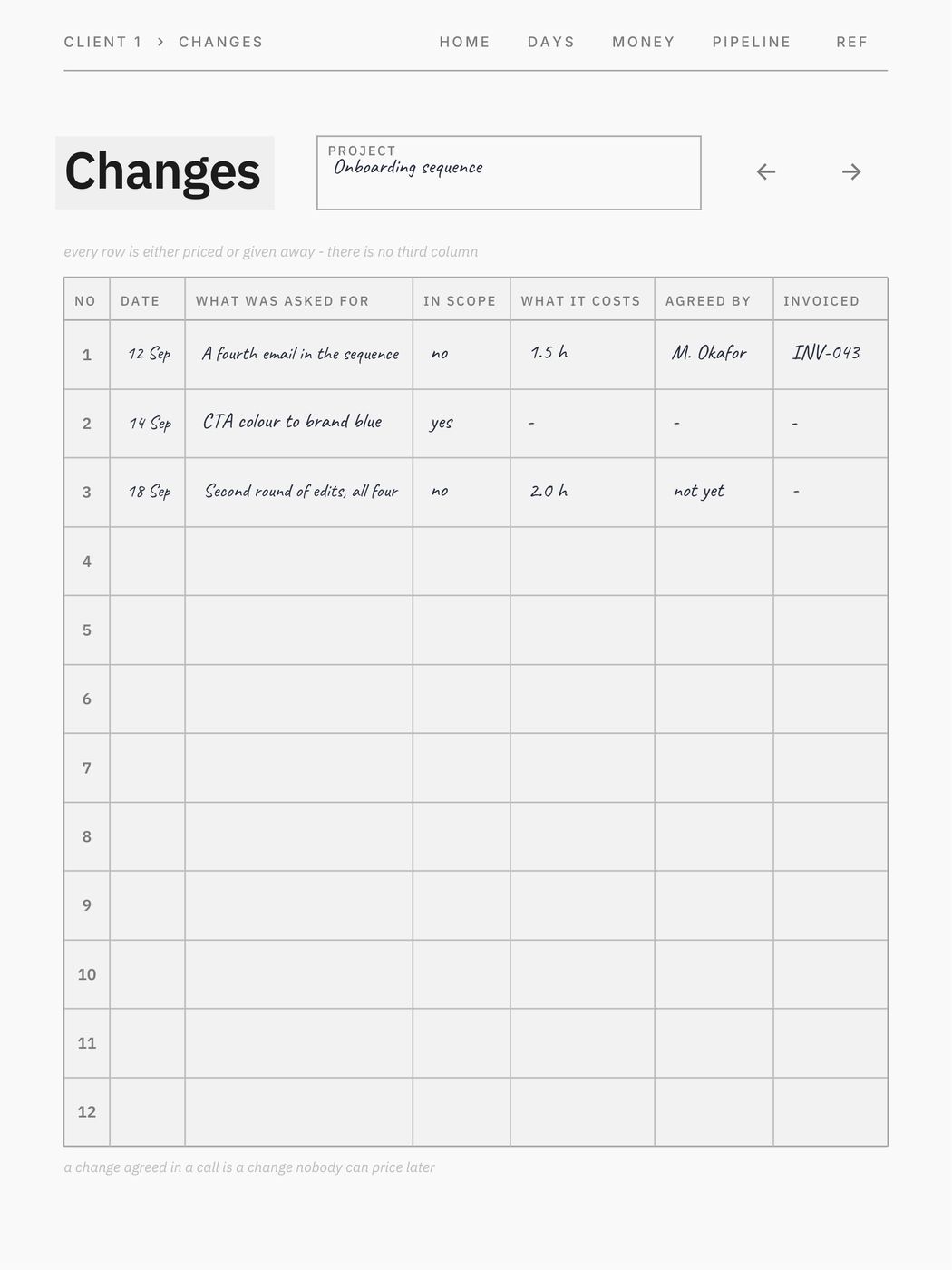
- 144 pages filed by client, not by date - eight clients, each with a record, a scope sheet, a change log and four call records
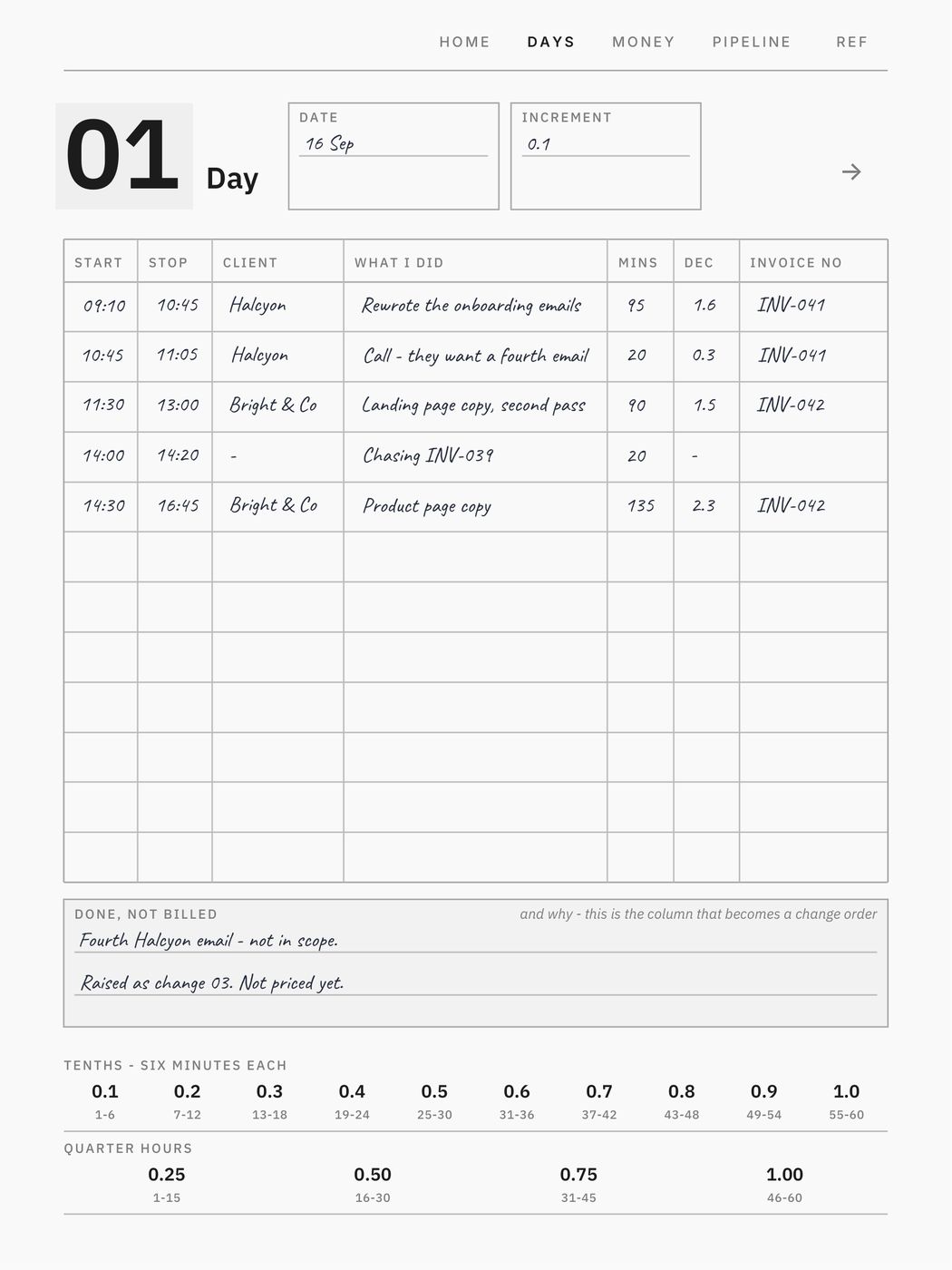
- 48 billable day sheets that carry a written line all the way to the invoice number it ended up on - nothing else on the market bridges handwriting to a sent invoice
- The conversion chart is printed on every day sheet, in tenths and quarter hours, because that is where the conversion is done
- Ten minutes is 0.17 of an hour, not 0.1 - printed, because it is the mistake that quietly costs a freelancer money all year
What is inside
An account book, not a planner — for the freelancer whose to-do list is fine and whose billing is not.
Filed by client: eight clients, each with a record, a scope sheet, a change log and four call records. Then 48 billable day sheets, twelve week summaries, an invoice tracker, expenses with mileage, and a pipeline log. 144 pages, all linked.
WHAT MAKES IT DIFFERENT
· The day sheet carries a written line all the way to the invoice number it ended up on. Every other template stops at the timer
· The conversion chart is printed on the day sheet itself, in tenths and quarter hours — where the conversion actually happens
· Ten minutes is 0.17 of an hour, not 0.1. Printed, because it is the mistake that quietly costs money all year
· The arithmetic of rounding is printed: 1 h 44 at 300/hr is 520 exact, 570 in tenths, 675 in quarter hours. Same work, three answers — so agree the increment in writing
· A done-but-not-billed box on every day sheet. That is where a change order starts, and it is the box no other planner has
· A change log with two outcomes per row: priced, or given away. There is no third column
· What an invoice must carry in the UK, listed — and the fact that the US has no federal equivalent, said plainly rather than flattened into one list
· No rate, threshold, percentage or filing date anywhere in the file. One page explains why: the US mileage rate changed in the middle of 2026
· No branding inside. You are buying paper, not an advert.