
Templates / For site, commissioning and test engineers
Field Engineers Set
Site, commissioning, test and plant engineers, and surveyors.
Revision letters skip I, O, Q, S, X and Z.
$14.99
Instant download · No account · All nine device editions
| Pages | 152 |
|---|---|
| Editions | mono, colour |
| Variants | right hand, left hand |
| Devices | reMarkable 2, reMarkable Paper Pro, reMarkable Paper Pro Move, Kindle Scribe, Kindle Scribe Colorsoft, Supernote Manta, Boox Note Air, A4 Print, US Letter Print |
| Format | Hyperlinked PDF, one file per device |
| Updates | Included, for as long as the template exists |
- 152 sheets across three jobs, every one designated - J2-CAL-03/16 is job two, calculation sheet three of sixteen
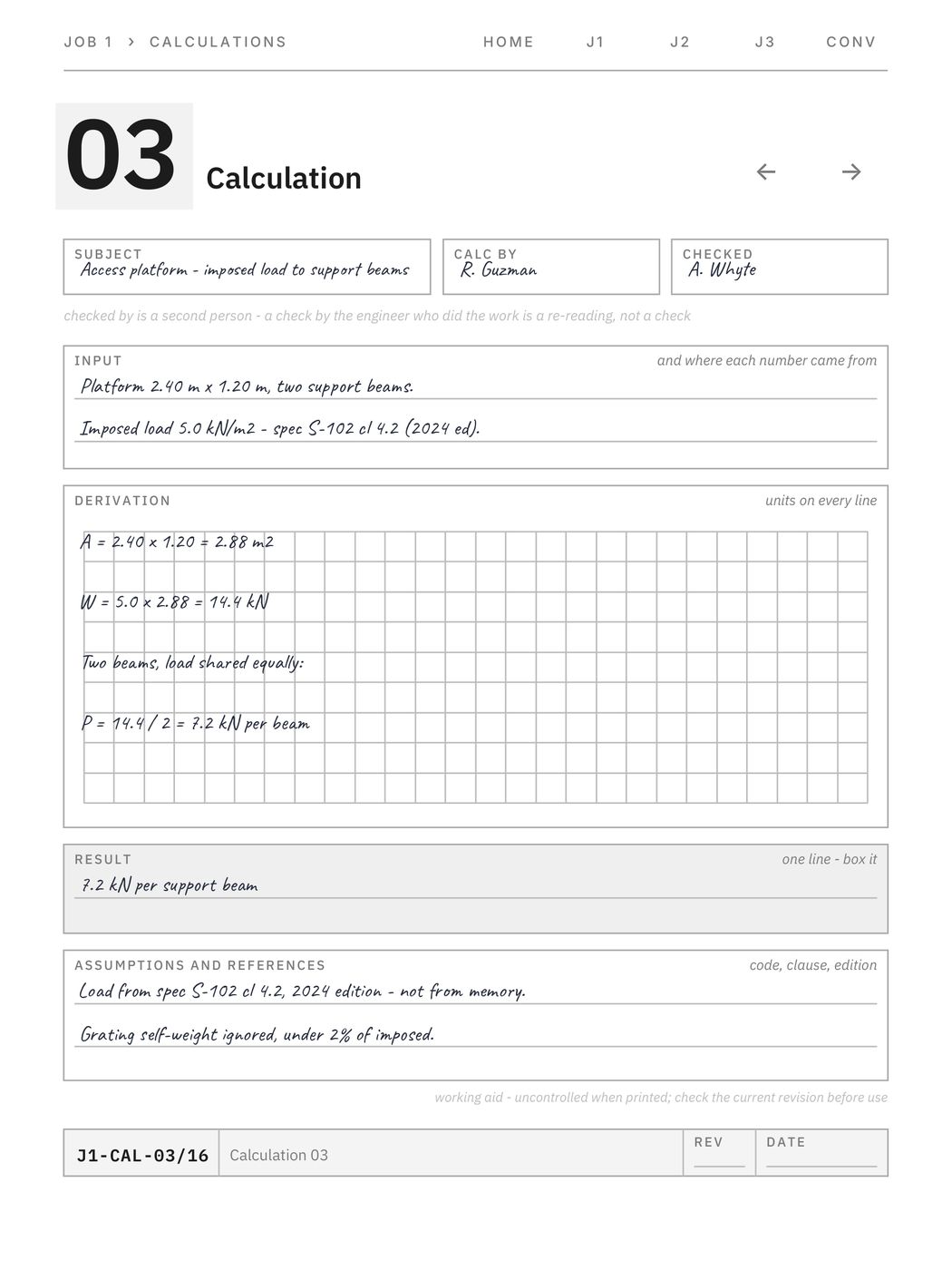
- 48 calculation sheets that keep input, derivation and result in three zones, with true five-millimetre squares under the arithmetic
- Calculated by and checked by are separate boxes, because a check by the engineer who did the work is a re-reading
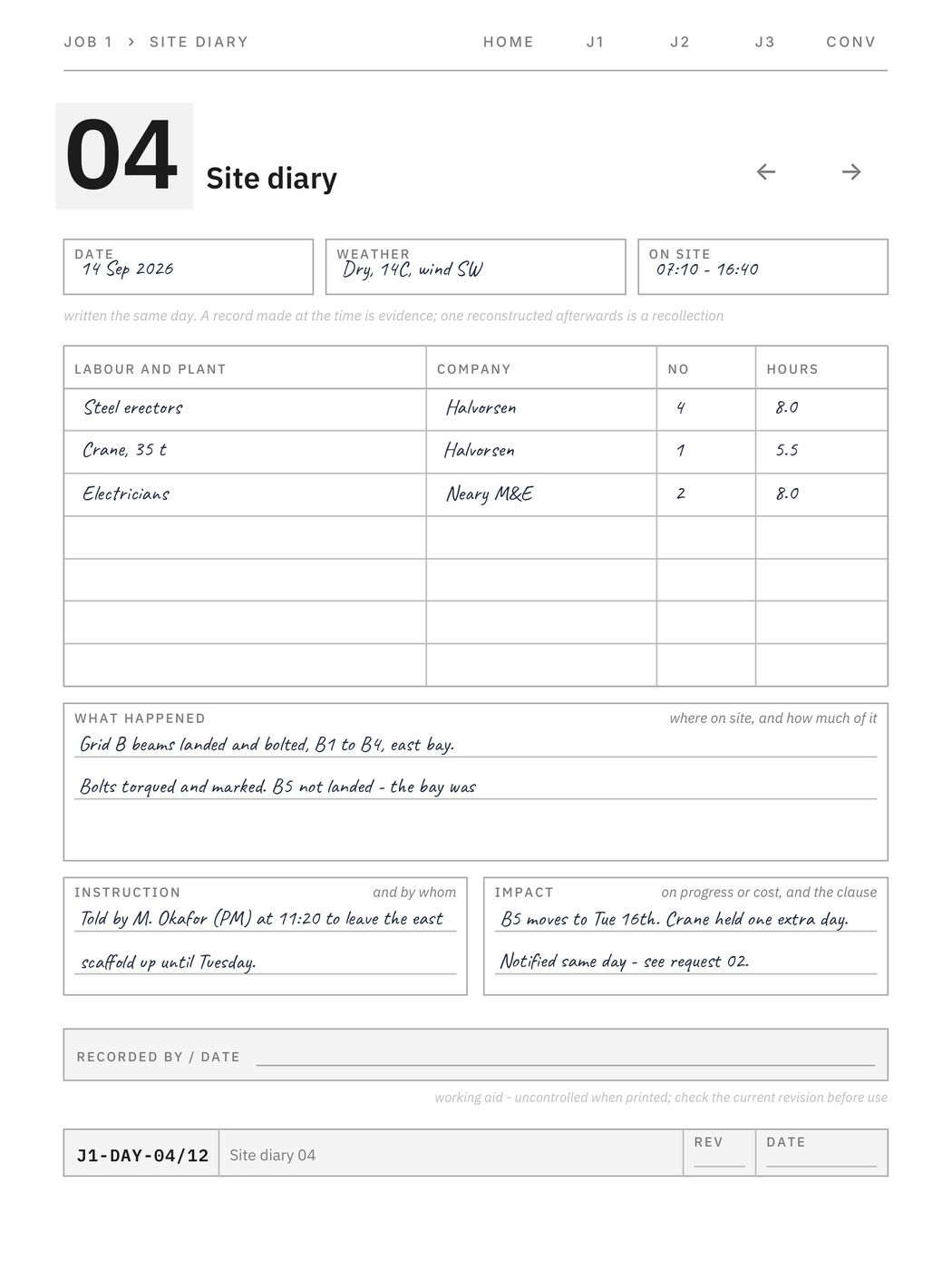
- 36 site diary days asking for weather, labour and plant, what happened and where, the instruction and who gave it, and the impact on progress or cost
- Every test record names the instrument, its serial number and its calibration due date - a reading from an instrument nobody can identify is not evidence of anything
- Every criterion column is blank on purpose: no allowable stress, factor, torque, tolerance or pass value is printed anywhere in this file, because those belong to your standard and its edition
- Revision letters skip I, O, Q, S, X and Z, as ASME Y14.35M has it, and the conventions sheet prints the run so a revision cannot be misread
- Requests carry the reply-required-by date and the line saying that neither the question nor its answer authorises work that adds cost or time
What is inside
A field book built the way a drawing office builds a sheet — for e-ink, not converted to it.
Three jobs, each with sixteen calculation sheets and a register of them, twelve site diary days, six test records, four requests and a request log, four snag lists and a drawing register. One hundred and fifty-two sheets, all linked, every one designated.
WHAT MAKES IT DIFFERENT
· The calculation sheet keeps input, derivation and result in three zones, with true five-millimetre squares under the arithmetic — because a column of figures drifts on ruled lines
· Calculated by and checked by are separate boxes. A check by the engineer who did the work is a re-reading, not a check
· The site diary asks for weather, labour and plant, what happened and where, the instruction and who gave it, and the impact on progress or cost — the fields that make a record contemporaneous rather than a recollection
· Every test record names the instrument, its serial number and its calibration due date. A reading from equipment nobody can identify afterwards is not evidence of anything
· Every criterion column is blank on purpose. No allowable stress, factor, torque, tolerance or pass value is printed anywhere in this file — those belong to your standard, its edition and your specification, and a printed value that disagrees with them is worse than an empty box
· Revision letters skip I, O, Q, S, X and Z, as ASME Y14.35M has it, and the conventions sheet prints the run so a revision cannot be misread
· Every sheet designated — J2-CAL-03/16 — so a sheet can be named on the phone rather than described
· Every sheet says it is a working aid, uncontrolled when printed. It sits beside your quality records; it is not one of them
· No branding inside. You are buying paper, not an advert.