
Templates / For genealogists and family historians
Family History
Genealogists and family historians.
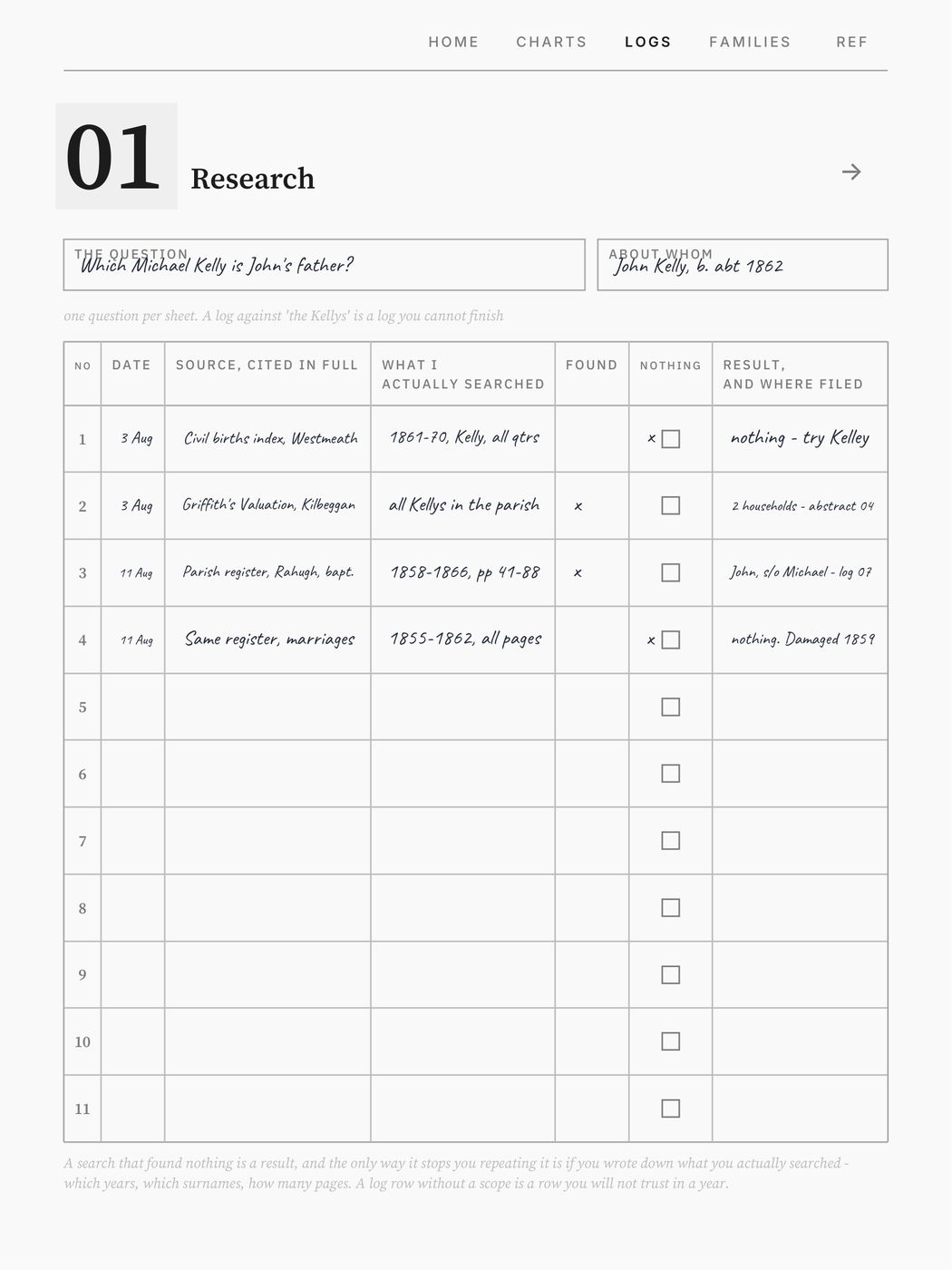
A column for the searches that found nothing.
$15.99
Instant download · No account · All nine device editions
| Pages | 156 |
|---|---|
| Editions | mono, colour |
| Variants | right hand, left hand |
| Devices | reMarkable 2, reMarkable Paper Pro, reMarkable Paper Pro Move, Kindle Scribe, Kindle Scribe Colorsoft, Supernote Manta, Boox Note Air, A4 Print, US Letter Print |
| Format | Hyperlinked PDF, one file per device |
| Updates | Included, for as long as the template exists |
- 156 pages, and twelve of them are census extraction sheets - the whole household, as written, with the reference the archive gives
- Every column says as written, because a census records what one person said on one night and the ages in it are frequently wrong
- Your own reading goes in square brackets, so in a year you can still tell which words were the enumerator's
- The sheet asks for the reference as the archive gives it rather than for a piece and folio, because census structures differ by country and by year
- 144 pages of desk work for people who keep the tree itself in software - the log, the abstract, the timeline and the letter, not another place to retype a family
- 48 research logs with the column nobody prints: what you actually searched - which years, which surnames, how many pages
- And a nothing-found column, because a negative result you did not write down is a search you will do again next winter
- Ahnentafel numbering printed with the rule: father is twice the child, mother is one more, even is male - so a number alone carries the whole line without a chart
What is inside
The desk work — for researchers who already keep the tree in their software.
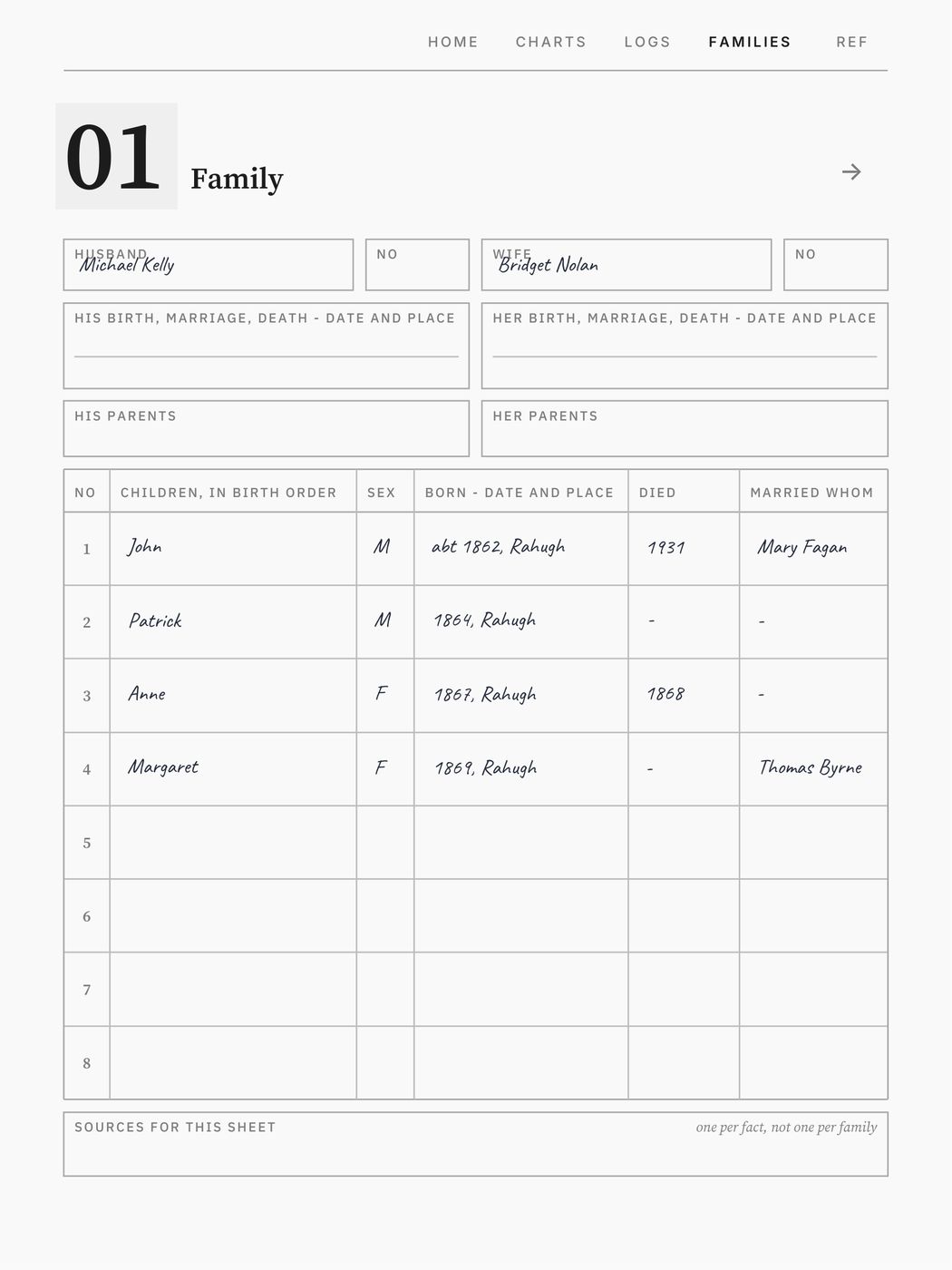
48 research logs, 8 pedigree charts, 24 family group sheets, 12 repository visit sheets, 14 document abstracts, 10 timelines, correspondence pages, DNA match pages and brick-wall worksheets. 144 pages, all linked.
WHAT MAKES IT DIFFERENT
· The research log has the column nobody prints: what you actually searched — which years, which surnames, how many pages — and a nothing-found column beside it. A hobbyist logs finds; a researcher logs failures with their scope
· Ahnentafel numbering printed with its rule, so a number alone carries the line: father is twice the child, mother is one more, even is male
· Pedigree charts that read father above mother, with the continuation handshake on both ends
· The date convention, and the argument for it: 12 Sep 1897, because 03/04/1897 is March in America and April in Britain
· Places smallest to largest, as the place was named at the time, with the empty comma kept so a county still reads as a county
· What a citation needs to be re-findable, and the reminder to put it on the copy itself — a photograph with no source becomes an unusable picture
· The five elements of the Genealogical Proof Standard, credited to the Board for Certification of Genealogists. Not affiliated; certifies nothing
· No centimorgan range, relationship prediction or ethnicity guidance. Those are interpretations and they belong to the tool that made them
· Living people are recorded as living, with details kept elsewhere
· No branding inside. You are buying paper, not an advert.