
Templates / For builders and trades on priced jobs
Contractors Job Book
Builders, trades and small contractors running priced jobs.
Work that is not agreed on this sheet is work you do for nothing.
$14.99
Instant download · No account · All nine device editions
| Pages | 140 |
|---|---|
| Editions | mono, colour |
| Variants | right hand, left hand |
| Devices | reMarkable 2, reMarkable Paper Pro, reMarkable Paper Pro Move, Kindle Scribe, Kindle Scribe Colorsoft, Supernote Manta, Boox Note Air, A4 Print, US Letter Print |
| Format | Hyperlinked PDF, one file per device |
| Updates | Included, for as long as the template exists |
- 140 pages across eight jobs of thirteen sheets each - the front sheet, two estimate pages, three variation sheets, two day works sheets, three diary pages, snags and the final account
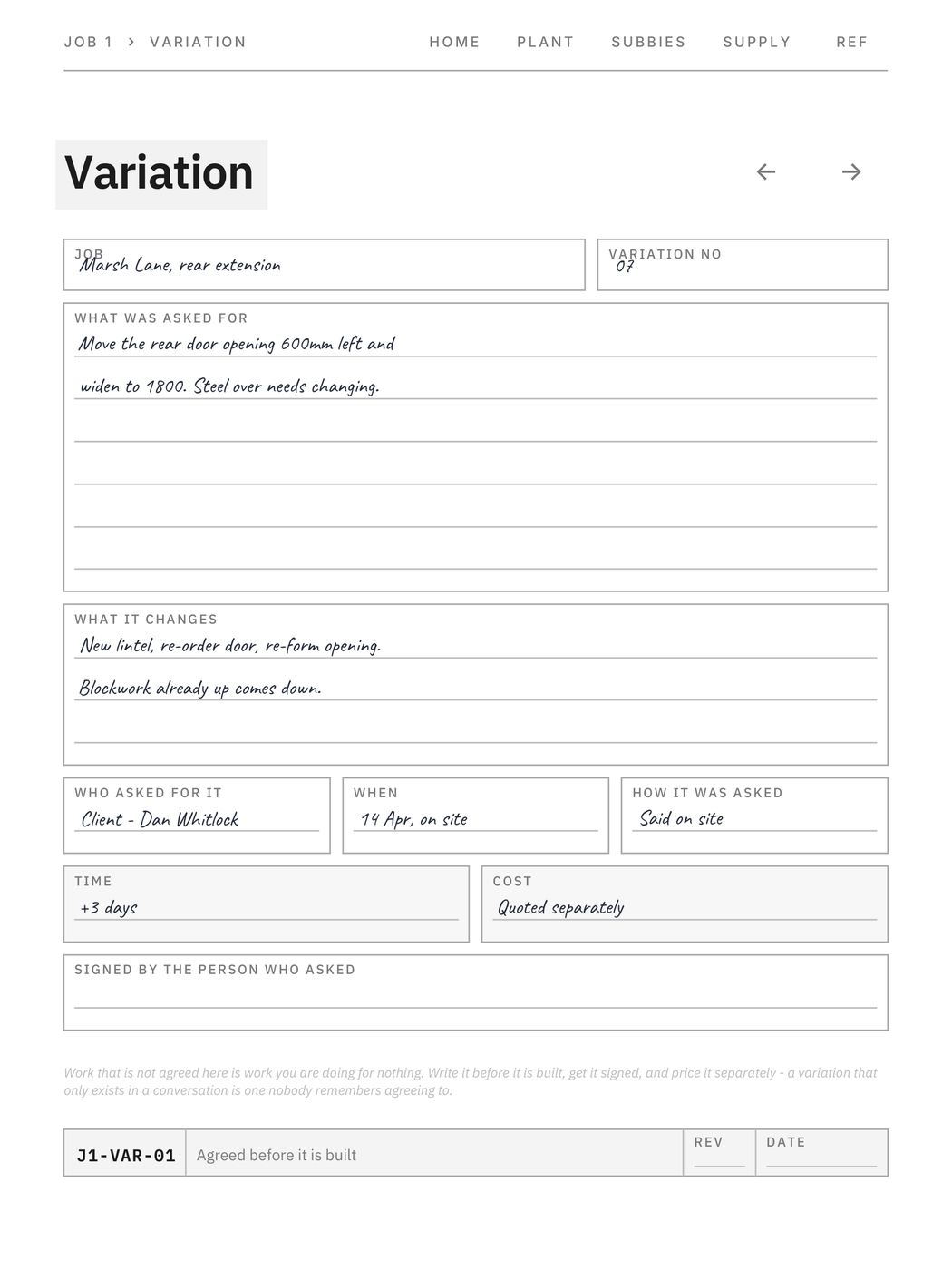
- A variation sheet built around the fact that a variation has to exist on paper before it is built - what was asked, who asked, when, whether it was in writing or said out loud, and a signature line for the person who asked
- Because the money a contractor loses is almost never the money priced wrong. It is the money for work that was done and never written down
- Printed on the sheet: work that is not agreed here is work you are doing for nothing
- Day works with labour, plant and materials on separate lines, because that is the only breakdown that survives being questioned - and a signature line for the day it was done, not the week after
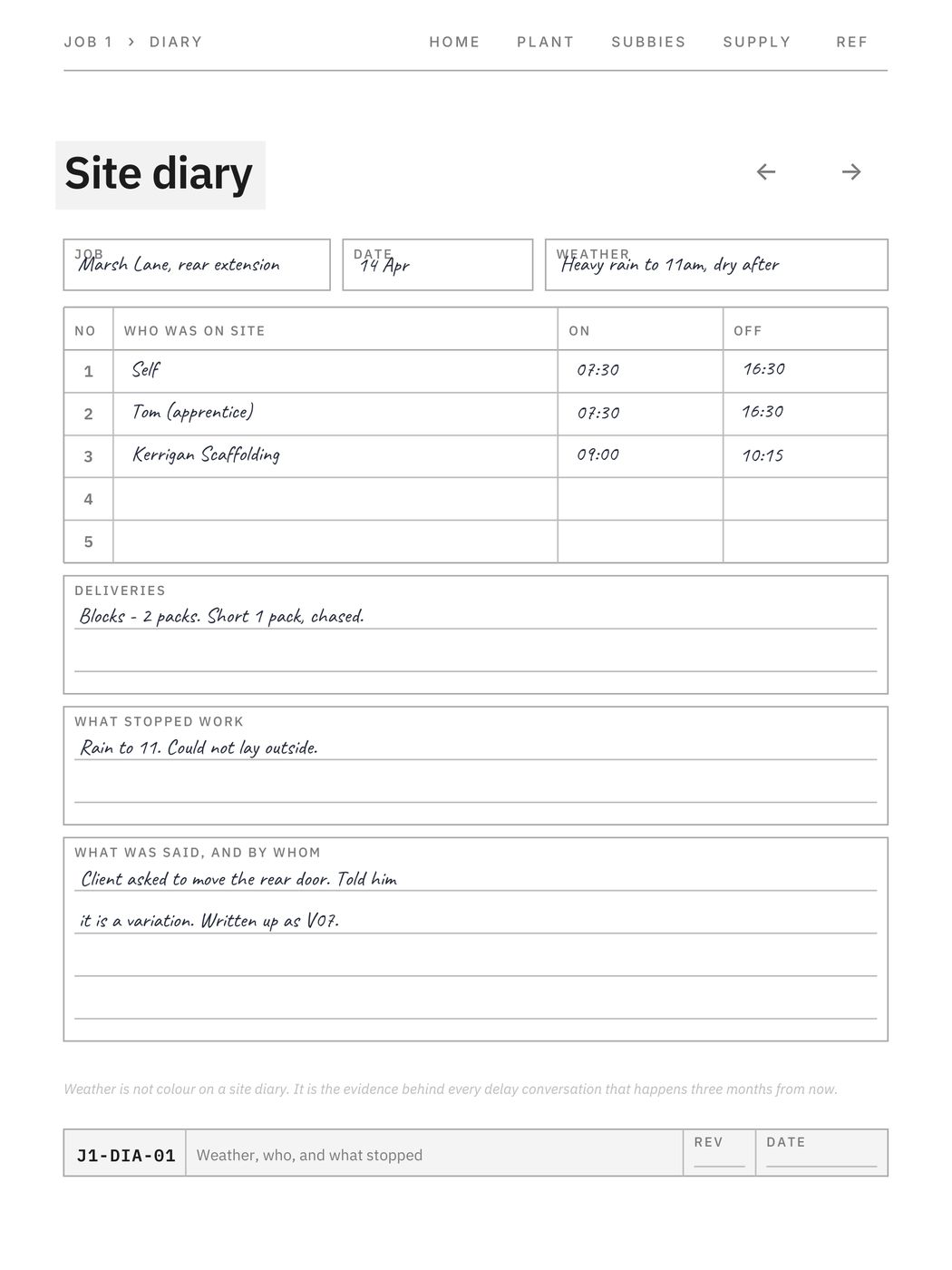
- A site diary that carries weather, because weather is not colour on a site diary. It is the evidence behind every delay conversation that happens three months later
- No contract wording of any kind. No clause, no standard form, no notice wording, and no term from any published contract - those are documents people pay for, and reprinting them would be theft dressed as helpfulness
- No labour rate, no day rate, no markup or overhead percentage, no tax rate, no retention percentage and no payment term is printed anywhere
What is inside
For the builder, electrician, joiner, plumber or small contractor who prices a job, runs it and gets paid for it - usually with nobody in the business whose actual job is paperwork.
140 pages across eight jobs of thirteen sheets each: the front sheet, two estimate pages, three variation sheets, two day works sheets, three diary pages, snags and the final account.
THE VARIATION SHEET
The money a contractor loses is almost never the money that was priced wrong. It is the money for work that was done and never written down - somebody asks for something on a Tuesday, it takes two days, and at the end of the job there is no record that anybody asked.
So the sheet is built to be filled in before the work is built:
· What was asked for, and what it changes
· Who asked, when, and whether they asked in writing or said it on site - because those are different positions to be in
· Time and cost, in their own boxes
· A signature line for the person who asked
Printed on the sheet: work that is not agreed here is work you are doing for nothing.
DAY WORKS, KEPT APART
Labour, plant and materials each get their own block with their own header, because a single total is a number that gets questioned and three separate ones is a number that gets paid. Signed on the day, not the week after.
THE SITE DIARY CARRIES WEATHER
Weather on a site diary is not colour. It is the evidence behind every delay conversation that happens three months later, and a diary without it cannot support one. Who was on site, on and off times, deliveries, what stopped work, and what was said and by whom.
NO CONTRACT WORDING, AND NO RATES
No clause, no standard form, no notice wording, and no term from any published contract. Those are documents people pay for, and reprinting them inside a template would be theft dressed as helpfulness. Nothing in this file is legal advice.
No labour rate, no day rate, no markup or overhead percentage, no tax rate, no retention percentage and no payment term is printed. Every rate column is blank, with one page at the front to write yours once and date it - because a printed number in a job book gets quoted from by somebody in a hurry, and it will not be your number.
ALSO INSIDE
· A snagging list with whose it is and when it was signed off
· A final account with as-priced, variations and day works in three separate columns rather than one total
· Plant, subcontractor and supplier registers that run across every job - including how long a supplier actually takes, against what they said
Hyperlinked throughout. Right- and left-handed editions, mono and colour, every device edition in the box. Personal use.